
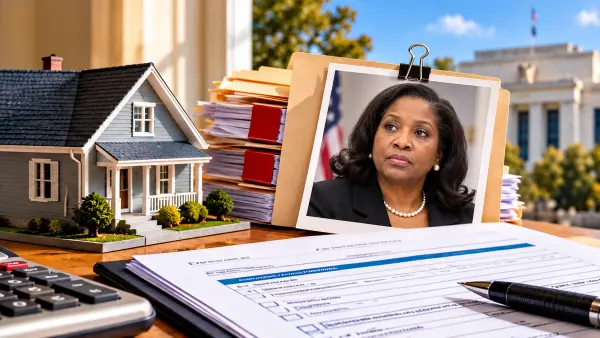
President Donald Trump has established a new White House committee to investigate allegations that Federal Reserve Governor Lisa Cook made false statements in mortgage applications. The committee will examine whether those allegations provide legal grounds for removing her from office.
The presidential memorandum, dated October 7 and publicized October 9, schedules a closed hearing for November 5, two days after the midterm elections. Cook must attend, answer questions and may present evidence in her defense.
The move renews a dispute over presidential authority, procedural fairness and the Federal Reserve’s independence from political pressure. Cook denies wrongdoing and has not been criminally charged.
Background
The Federal Reserve is the United States’ central bank. Its Board of Governors helps oversee the financial system and set monetary policy, including decisions that influence interest rates, inflation and employment.
Congress designed the Federal Reserve to have considerable independence from the White House. Under the Federal Reserve Act, governors serve staggered 14-year terms and can be removed by the president only for cause.
That protection differs from the rules governing many other senior executive officials, whom presidents can generally dismiss more freely.
Cook was appointed by President Joe Biden in 2022 and became the first Black woman to serve on the Federal Reserve Board. Her term runs until 2038.
In August 2025, Federal Housing Finance Agency Director Bill Pulte accused Cook of making inconsistent representations about the occupancy status of properties in mortgage documents. According to PBS NewsHour, Trump alleged she declared two properties as her primary residence in 2021 mortgage applications. Trump then attempted to remove her.
Cook challenged the dismissal, arguing that the allegations were unproven and that she had been denied adequate procedural protections. The Supreme Court allowed her to remain in office while the dispute continued. In June 2026, it ruled that she could keep her job for now, saying a final decision could come only after she has had a chance to respond to the charges.
The Court also said removal for cause requires an alleged offense that is serious and related to the official’s job. A footnote noted that nothing prevents Trump from trying again if Cook receives proper notice and an opportunity to respond. The new committee is that second attempt.
What the New Committee Will Do
The October 7 presidential memorandum establishes a three-member committee consisting of White House economic adviser Kevin Hassett, Equal Employment Opportunity Commission Chair Andrea Lucas and Keith Sonderling, acting director of the Office of Government Ethics.
The committee must investigate the mortgage allegations and determine whether they constitute legal cause for Cook’s removal under federal law, as interpreted in the Supreme Court’s 2026 ruling. It may consult executive agency personnel, including the Justice Department.
Before the hearing, the committee must give Cook the evidence it is considering. She may submit a written position statement at least three days before the November 5 hearing. She may also present documentary evidence, written witness statements and arguments through her attorneys, and she must comply with committee requests for documents. Committee representatives, including Justice Department personnel, may question her.
The hearing will take place at the White House, last no longer than four hours and remain closed to the public, although a transcript will be prepared.
Cook may submit a final written statement by November 10. The committee will then deliver written findings of fact and conclusions of law to Trump, along with a recommendation on whether cause exists.
According to ABC News, no president before Trump had attempted to remove a Federal Reserve governor in the central bank’s history.
What Different Sides Are Saying
The Administration: Accountability and Presidential Responsibility
The White House argues that the president has a responsibility to ensure federal officials act honestly and comply with the law.
Trump’s memorandum says the committee will help determine whether the allegations satisfy the statutory standard for removal. Supporters of the inquiry argue that central bank independence should not shield officials from accountability for serious misconduct.
Fact-check: Federal Reserve governors can legally be removed for cause. However, that does not mean a president can dismiss one simply because of political disagreement or an accusation. The statute does not define cause, and the Supreme Court has said the alleged offense must be serious and related to the official’s job. Whether the mortgage allegations meet that test is central to Cook’s litigation.
The administration also argues that the new hearing will provide Cook with an opportunity to respond, addressing procedural objections raised during the earlier removal attempt.
Fact-check: The memorandum does provide for evidence disclosure, legal representation and written submissions. Whether that process satisfies constitutional and statutory requirements, including concerns about the committee’s independence, remains open to legal challenge. This article could not verify whether the committee’s members have any prior involvement in the allegations.
Cook’s Defense: Unproven Allegations and Political Pressure
Cook denies committing mortgage fraud. In 2025, her attorneys described the occupancy discrepancy as an inadvertent error, not fraud. They also argue that the allegations do not establish a lawful reason for dismissal and that the removal attempt stems from her refusal to lower interest rates. That motive claim is the attorneys’ allegation, not an established fact.
Her lawyers, Abbe Lowell and Norman Eisen, have said they have “grave doubts” the hearing will be legitimate. They say Cook welcomes the chance to present the facts and are weighing whether she will appear.
Fact-check: Cook has not been convicted of or charged with mortgage fraud. That distinction matters, but a criminal conviction is not necessarily required for every form of legally sufficient cause for removal. The question is whether the established facts, if any, meet the governing statutory standard.
Economists and Legal Experts: The Independence Question
The controversy also concerns a broader principle: should presidents be able to influence monetary policy by removing central bank officials?
Supporters of Federal Reserve independence argue that elected officials have incentives to seek lower interest rates and stronger short-term economic growth, particularly before elections. Central bankers, by contrast, are expected to consider longer-term inflation and financial stability.
Some critics of the process question its design. Scott Alvarez, a former Federal Reserve chief counsel, has argued that the committee goes beyond the process the Court required and that the allegations do not appear to meet the cause standard. That is an expert opinion, not a ruling.
Other legal scholars emphasize that presidential accountability remains an important constitutional principle and that independence cannot justify immunity from legitimate oversight.
Fact-check: Federal Reserve independence does not mean the institution operates without accountability. Congress establishes its statutory responsibilities, receives testimony from its leadership and can amend the laws governing it. The contested question is how much direct removal authority the president should exercise.
What Happens Next?
The committee is scheduled to hear Cook’s response on November 5 and consider a further written submission by November 10.
It will then recommend whether Trump has cause to dismiss her. Any new dismissal decision could generate additional litigation.
The outcome may influence the relationship between the presidency and the Federal Reserve well beyond Cook’s individual case. It could help define what kinds of alleged misconduct justify removing a governor and what process must precede that decision.
Note on Scope
The new committee is investigating allegations, not announcing a finding of wrongdoing. Cook remains a Federal Reserve governor, and the hearing has not yet occurred.
The public allegations and administration memorandum do not independently establish that Cook intentionally made false mortgage statements. Nor do questions about the administration’s political motives establish that the allegations are necessarily false.
Related Links
- White House: Committee of Inquiry Memorandum
- PBS NewsHour: Trump Establishes Committee to Investigate Cook
- ABC News: Trump Announces Committee to Investigate Cook
- Federal Reserve: Lisa Cook Biography
- Federal Reserve Act: Section 10
- Federal Reserve: Structure and Responsibilities
Discussion Questions
- What should qualify as sufficient cause for removing a Federal Reserve governor?
- Should an allegation of financial misconduct justify removal from office before it is proven in court?
- How independent should the Federal Reserve be from the president?
- Does a hearing organized by presidential appointees provide adequate procedural fairness?
- Should Federal Reserve governors face different removal standards from other senior government officials?
- Can a president legitimately disagree with monetary policy without threatening central bank independence?
- What evidence would you need before deciding whether Cook should be removed?
- Should the November 5 hearing be open to the public?
- How might easier presidential removal of central bankers affect inflation expectations and financial markets?
- How should democratic accountability and long-term monetary stability be balanced?
