
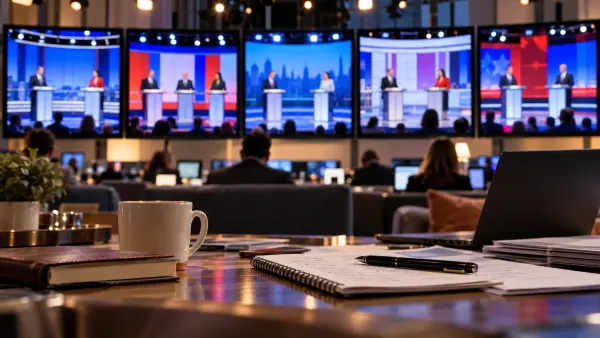
Six debates on October 8 put three Senate seats, two governorships and one open House seat in front of voters, and the sharpest disputes were over the Iran war, tariffs and personal conduct. Michigan’s Senate candidates traded insults for an hour, Georgia’s Jon Ossoff and Mike Collins clashed over bigotry allegations and tariffs, and Maine’s Susan Collins and Troy Jackson accused each other of ethics problems. Maine’s gubernatorial candidates agreed more than their campaigns’ attacks suggest, Alaska’s four candidates for governor shared one statewide stage, and Iowa’s 2nd District candidates argued over tariffs and a proposed steel mill. This dispatch covers what each candidate said, how they framed the stakes, which claims could be checked and how the coverage described the night.
Michigan Senate: Insults Overshadow a Split on Iran and Health Care
WOOD-TV hosted the debate in Grand Rapids, the first time Republican Mike Rogers and Democrat Abdul El-Sayed shared a stage in the race for the seat Sen. Gary Peters is leaving. Rogers had skipped a September 15 debate hosted by a Detroit station, and the reasons given in the coverage differ, as noted below.
According to CBS News, the hour was dominated by insults. El-Sayed called Rogers a sockpuppet for the Trump administration, and Rogers called El-Sayed a “glitchy AI chatbot” running a con. Moderator Rick Albin intervened repeatedly, and the two were still arguing during a commercial break.
Iran produced the clearest policy split, in a war covered in our US-Iran war explainer. Rogers said it was time to wrap up the war and argued that Iran’s nuclear and conventional capabilities are badly degraded. El-Sayed opposed the war, said Rogers has a direct line to President Trump that he is not using to end it, and pointed to the Obama-era agreement limiting uranium enrichment as the diplomatic model. Asked whether Iran or Israel is the bigger threat, El-Sayed called the question a hypothetical and declined to choose, while Rogers described himself as a strong supporter of Israel who would back defensive weapons for it. Fox News reported that Rogers also accused El-Sayed of ties to groups supportive of terrorism, which El-Sayed disputed.
Both candidates backed pausing the gas tax. Rogers opposed federal price controls on domestic oil and offered temporary gas tax relief, diesel rebates and a pause on diesel exports, while El-Sayed said price controls were worth considering and blamed the Iran conflict for high prices. On Canada, Rogers said the trade dispute needs to end and that he had discussed a deal with Commerce Secretary Howard Lutnick, and El-Sayed argued Rogers would not stand up to Trump. On immigration, Rogers said the intense Minnesota operations were probably not appropriate but that agents now target violent offenders, and El-Sayed, who wants ICE abolished, said violent offenders should be deported but not by violating the Constitution.
Health care followed the same pattern. Rogers called Medicare for All dangerous and said it would take over private insurance and raise taxes on families, and El-Sayed said families who want to keep private coverage can. Fox News also reported that Rogers questioned El-Sayed’s medical credentials and his statements about citizenship, while El-Sayed accused Rogers of profiting from corporate ties after leaving Congress. Each candidate raised the other’s property, with El-Sayed citing a waterfront home Rogers owns in Florida and Rogers citing a rental property owned by El-Sayed’s wife in the United Arab Emirates.
Fact-check: The Medicare for All dispute may turn on definitions. Whether keeping private coverage and displacing private insurance conflict depends on whether supplemental plans count, and this article could not locate the text of El-Sayed’s specific proposal. The terrorism-ties accusation, the medical credentials and citizenship attacks, the two property claims and Rogers’s assessment of Iran’s degraded capabilities are all assertions by one candidate that this article could not verify. The one point of agreement, pausing the gas tax, is a stated position from both.
Coverage: Reporting centered on tone, and headlines in the Related Links below used words such as raucous, hostile and off the rails. On polling, a Mitchell Research & Communications poll had El-Sayed ahead 45.6% to 41.4% among likely voters with 6% undecided, while the Fox News report cited a late-September Fox News poll with El-Sayed ahead 50% to 49%. These are different pollsters with different dates and are not averaged here, and this article could not confirm Mitchell Research’s field dates. The same CBS Detroit report said Rogers skipped the September debate saying he never agreed to attend, while Fox News said he cited doubts about the moderator’s impartiality. The two statements are not necessarily in conflict, and this article could not locate Rogers’s own explanation. For the race’s full background, see our Michigan Senate briefing.
Maine Senate: Corruption Charges, Trump’s Shadow and a Rare Overlap on Social Security
WMTW hosted the Collins-Jackson debate in Westbrook at 8 p.m., the second of four debates scheduled over 10 days. The Boston Globe reported that it opened with a ProPublica story alleging that Collins steered government contracts to a Hawaii business in return for campaign donations, which Collins denied. Jackson was then pressed on corporate PAC money accepted during his time as state Senate president, and he said it did not affect his votes. Another account said Jackson pressed Collins on a report that the FBI had circled her campaign as late as 2024 over the alleged scheme, which she also denies.
The night’s sharpest exchange came over Iran. Jackson blamed the war for rising fuel and electricity prices and accused Collins and her husband of profiting from it through natural gas and Boeing stock holdings. The Portland Press Herald reported that Collins called the charge “absolutely outrageous” and demanded an apology, and Jackson replied that she owed him one. Jackson also said Collins voted five times against stopping the war, while Collins said she has voted nine times to end it.
Jackson framed the race as a referendum on Trump, arguing that Collins is powerful at election time but weak when Mainers need her to stand up to the president. Collins framed it around seniority, citing $1.5 billion she has brought to Maine as Appropriations Committee chair and the fact that she is the first Mainer to hold that post in 92 years. She also said she has voted against Trump 137 times and has sided with him 72% of the time across his second term, while Jackson put the figure at 96%. Collins attacked Jackson’s past opposition to abortion rights, which Jackson said he has since reversed after listening to women, and she accused him of favoring Supreme Court expansion. Jackson called for defunding ICE after a fatal July shooting, and Collins defended the agency’s work against violent criminals while backing further reform and body cameras. Our report on ICE pausing vehicle stops after fatal shootings in Maine and Texas is related background.
The two found one overlap. Both said higher earners should pay more into Social Security, whose payroll tax applies only to the first $184,000 of income, per the Press Herald. Jackson wants to scrap the cap, while Collins said she agreed with him in part but proposed a panel of independent experts to recommend changes.
Fact-check: The vote counts are not necessarily in conflict, since five votes against stopping the war and nine votes to end it could describe different measures, and this article could not locate the roll calls. The Trump-alignment figures use different methods and are not averaged: Jackson’s 96% compares with a CQ Roll Call analysis the Press Herald said put the figure near 95% for the first seven months of 2025, while Collins’s 72% covers the full second term. The stock-holdings allegation is unverified here, and the Globe reported that Jackson did not explain it. Collins’s claim that Maine’s electric rates rose to fourth-highest in the nation under Jackson’s leadership also could not be verified, though PolitiFact’s headline says it checked electric rates, Roe v. Wade and Iran. This article could not open that page, so its ratings are not reported.
Coverage: Globe columnist James Pindell called the first debate a “mess” and this one more substantive, though he doubted undecided voters learned much. Other headlines, listed below, stressed corruption barbs and Supreme Court exchanges. For the race’s background, see our Maine Senate briefing.
Georgia Senate: Bigotry Allegations Collide With a Fight Over Tariffs and Medicaid
Atlanta News First hosted the first of two Ossoff-Collins debates, an hourlong event broadcast statewide on Gray Media stations at 7 p.m. and moderated by anchor Rick Folbaum with a panel of six journalists. CBS Atlanta reported that Democratic Sen. Jon Ossoff is the only Senate Democrat defending a seat in a state Trump won in 2024, and that Republican Rep. Mike Collins has Trump’s endorsement and the backing of Gov. Brian Kemp. The two meet again Tuesday in the Atlanta Press Club’s Loudermilk-Young Debate Series.
Economic questions split along familiar lines. Mike Collins blamed inflation on President Biden’s economic plans and a Green New Deal vote by Ossoff, and defended Trump’s tax bill as having put money back into the economy. Ossoff, who voted against that bill, blamed tariffs and the Iran war, said he wants to repeal the tariffs and end the war, and told voters to judge the bill by their gas, grocery and electric bills. Collins also accused Ossoff of backing a 48-day government shutdown that defunded border patrol and ICE instead of passing farm aid after Hurricane Helene. Fox 5 Atlanta reported that Ossoff said he negotiated a tariff cut on agricultural exports such as pecans, but that family farms are still struggling.
On health care, Collins blamed Affordable Care Act mandates for rising premiums and cited the tax bill’s rural hospital support, while Ossoff blamed Republican Medicaid cuts for rural hospital closures, including one in Collins’s district, and called for Medicaid expansion. Both said local communities should have a say over data centers, though Ossoff argued Collins’s vote for the tax bill benefited developers. Both voiced concern about misuse of license plate cameras, a bipartisan issue we covered in our report on Flock camera scrutiny, and Collins said the data should require a warrant. Ossoff supports Georgia’s voter ID law but accused Collins of still pushing to overturn the 2020 election, while Collins argued for ID requirements. On immigration, Collins cited his role in the Laken Riley Act and called for reforming H-2A farm visas, and Ossoff cited his work with Sen. John Cornyn on drug detection equipment at ports and criticized federal enforcement abuses.
On Israel, Ossoff defended his vote to block some arms shipments, said Israeli forces violated humanitarian law in Gaza while supporting Israel’s security, and avoided calling the war a genocide, deferring that question to the International Criminal Court. Collins linked Ossoff to commentators and candidates he described as anti-Israel.
The sharpest exchanges were personal. Ossoff framed the race as a trial of Collins, accused him of bigotry and ties to white nationalists, and asked him to release communications between his former chief of staff, Kip Talley, and a group that included Nick Fuentes and Richard Spencer, which Slate had reported. Collins dismissed the accusations, said he condemns racism and antisemitism, and said he had fired a staffer. He called Ossoff a “trust fund kid” who never had a real job, and said Ossoff’s donors included a Silicon Valley investor with past Epstein ties.
Fact-check: This article could not verify the 48-day shutdown figure or Collins’s description of what the shutdown funded, and it could not tell which staffer Collins said he fired. It also could not independently confirm the Slate-reported communications, the Epstein-ties donor claim, Ossoff’s pecan tariff negotiation, the rural hospital closure in Collins’s district, or either side’s claim that the tax bill helped or hurt data center developers and rural hospitals. Both candidates described the Medicaid and tax bill record in opposite terms, and each description is a campaign assertion here.
Coverage: CBS Atlanta described the exchange as combative, and headlines in the Related Links below stressed personal insults. Per CBS Atlanta, Cook Political Report and the University of Virginia’s Center for Politics both rate the race Likely Democratic, and recent InsiderAdvantage, Big Data Poll and YouGov polls show Ossoff ahead by 8, 10 and 10 points as listed. Forecaster ratings and polls from different organizations are shown separately and not averaged, and this article could not confirm the polls’ field dates. For the race’s full background, see our Georgia Senate briefing.
Maine Governor: Charles Targets Pingree, With Surprising Agreement on Housing
The second of four gubernatorial debates took place at Husson University’s Gracie Theatre in Bangor, hosted by the Portland Press Herald, Maine Public and NEWS CENTER Maine, with Maine Public’s Jennifer Rooks moderating. Democrat Hannah Pingree, Republican Bobby Charles and independent Rick Bennett took part. The Press Herald’s takeaways said the debate resembled the first: Charles, who the paper said trails in polls by double digits, attacked Pingree, while Pingree largely ignored him and tied Charles to Trump on tariffs and the Iran war.
Charles said housing costs doubled under Gov. Janet Mills and Pingree, who served in the Mills administration, and in his closing criticized $840,000 in state funding to a nonprofit Pingree once led that employs her husband and family. He again distanced himself from Trump on tariffs and called Canada a friend. Bennett, who left the Republican Party last year, criticized both major parties and called the two-party system the “political industrial complex.”
The candidates agreed on more than the attacks suggested. All three said housing production is too slow, with Pingree proposing a 90-day environmental permitting shot clock, Charles pushing municipalities to speed permitting, and Bennett proposing an audit of the state’s housing bottleneck. All three acknowledged problems with the health care workforce and rural hospitals, and Charles and Bennett agreed reimbursement rates must rise. Pingree and Bennett also agreed that immigration enforcement has gone too far, that data center development should pause and that Maine’s tribes should have sovereignty, and Charles and Bennett agreed the budget shortfall stems from overspending.
Fact-check: This article could not verify that housing costs doubled under Mills, or the $840,000 funding figure and its connection to Pingree’s family. Maine Public’s earlier report on the two candidates’ spending and conflict-of-interest dispute is listed below. This article also could not locate the polls behind the claim that Charles trails by double digits.
Alaska Governor: Four Candidates, One Democrat and a Split Republican Field
The first of three “Debate for the State” broadcasts, produced by Alaska Public Media and Alaska’s News Source and moderated by Lori Townsend, drew all four candidates on the general election ballot: Democrat Jonathan Kreiss-Tomkins and Republicans Dave Bronson, Treg Taylor and Bernadette Wilson. A timed recap from WebCenter Fairbanks shows the main divide ran between Kreiss-Tomkins and the three Republicans, with a quieter contest among the Republicans over how conservatives should vote under Alaska’s ranked choice system.
On the budget, Bronson blamed stalled resource development for a gap of roughly $2 billion a year and said a full dividend is out of reach until the Permanent Fund grows. Kreiss-Tomkins pledged a balanced budget, called for Hilcorp to pay corporate income tax and said a $4,000 dividend would drain the fund. Taylor rejected tax increases and proposed a constitutional amendment tying the dividend to oil revenue, and Wilson proposed zero-based budgeting, a spending cap and agency audits. Wilson, Bronson and Taylor opposed returning to a state pension system, and Kreiss-Tomkins was the lone supporter.
Energy and costs drew more overlap than conflict. Bronson wanted a second Cook Inlet drilling rig, Kreiss-Tomkins and Taylor backed royalty relief and tax incentives, and Wilson blamed the state’s tax climate. Taylor and Wilson called the gas line the biggest lever on living costs, and Taylor cited 5,000 construction jobs and 1,000 permanent ones. Kreiss-Tomkins pointed to permitting reform, child care costs and a broad energy approach.
The ranking question, which matters under the system our Alaska Senate briefing explains, exposed the Republican split. Taylor said he would rank Bronson second and urged Republicans to rank all three Republicans, and Bronson said he would rank Taylor second. Wilson declined to answer, and Kreiss-Tomkins ranked himself and his running mate first. Wilson dismissed the conciliatory tone on polarization, while Bronson said refusing to compromise is why the state is in this mess, and in his closing Kreiss-Tomkins called Wilson’s campaign “running for Mike Dunleavy’s third term.”
Fact-check: This article could not verify Bronson’s $2 billion gap, Kreiss-Tomkins’s claim that a $4,000 dividend would drain the fund or Taylor’s job figures, and it found no independent fact-check of the debate. Coverage: This article could not locate a post-debate analysis or named-outlet reporting on social media reaction. The recap is the only account of what was said, and it summarizes rather than transcribes.
Iowa’s 2nd District: Tariffs, Taxes and an Open Seat
Iowa PBS broadcast an hour-long Iowa Press debate from Johnston, moderated by Kay Henderson. Democrat Lindsay James, a state representative from Dubuque, faced Republican Joe Mitchell, a former state representative from Clear Lake, for the seat Rep. Ashley Hinson is leaving to run for the Senate, a race covered in our Iowa Senate briefing. The district covers 22 counties, including Mason City, Dubuque and Cedar Rapids. KCRG reported that the debate centered on taxes, tariffs, trade, the deficit and term limits.
Tariffs split the candidates. James said they should be rolled back because they raise costs for families and farmers, and Mitchell said they have helped farm commodity prices and will benefit future generations. Mitchell credited tariff policy for a proposed $15 billion steel mill in Lee County. James called Mitchell out of touch with working families, and Mitchell answered that she was a hypocrite for supporting the mill while criticizing tariffs.
On fiscal policy, James said a $40 trillion figure the outlet called the deficit could be reduced if the ultra-wealthy paid more. Mitchell said the focus should be waste, fraud and abuse and accused James of backing higher taxes, and he said she voted against a property tax bill last year. James called that “absolutely misleading.” Both agreed on term limits, with Mitchell saying 12 years in Congress is enough and James also wanting age limits.
The Iran war also came up. KTTC reported that James said “upwards of $47 billion” has gone to the war, and called for ending it immediately. Mitchell said he wants the conflict to end but in the most strategic way possible, and he called recent Democratic war resolutions a knee-jerk partisan action to defy the president. Artificial intelligence and data center regulation were also on the agenda, but the sources read for this article did not report the candidates’ positions.
Fact-check: A figure of $40 trillion describes cumulative federal debt, not an annual deficit, so the outlet’s description may be a reporting error or a mix-up by the candidate, and this article could not tell which. It also could not verify James’s $47 billion cost, Mitchell’s claim that tariffs drove the steel mill decision or his account of James’s property tax vote. Coverage: Local reports described the candidates as sparring, with no major fact-checking found by publication.
View from Outside the US
Canadian outlets have covered the Michigan and Maine races mainly through trade. A Reuters report carried by BNN Bloomberg said the US put 50% tariffs on about $20 billion of Canadian goods in August, and that Canada’s retaliatory tariffs of 15% to 50% on about $20 billion of US goods took effect September 8. It reported that Canada accounted for 69% of Maine’s imports and 41% of its exports in 2025, and that Cook Political Report rated both the Maine and Michigan Senate races as toss-ups at that time. Canada’s industry minister, Melanie Joly, said in August that Canada was wise and strategic to put political pressure on the US.
That context frames Rogers’s call to end the Canada dispute in Michigan, though the sources read for the Maine Senate debate did not report trade as a major topic on October 8. Our report on a Michigan border town covers local effects.
Note on Scope
This dispatch relies on published reports rather than full transcripts or video, so word choices and some figures are as reported. Reporting is current as of October 9, 2026. PolitiFact published fact-checks of both the Michigan and Maine Senate debates, but this article could not open either page, so no ratings are reported. Several additional reports on the Georgia debate could not be opened, so that section rests on two accounts. This article did not find social media reaction attributed through a named outlet for any of the six debates. It does not judge who won any debate.
Related Links
- PolitiFact: Fact-check of the Michigan Senate debate
- PolitiFact: Fact-checking the Maine Collins-Jackson debate
- Detroit News: El-Sayed, Rogers debate rife with interruptions
- Newsweek: Collins, Jackson trade jabs over packing the Supreme Court
- Maine Public: Charles and Pingree spar over spending and conflicts
- Georgia Recorder: Collins, Ossoff trade personal insults in first debate
- Iowa PBS: Iowa Press Debates, 2nd Congressional District
Discussion Questions
- Have you ever watched a political debate? How did it affect your view of the candidates?
- Do personal insults in a debate change how you see a candidate, for better or worse?
- Which matters more to you in a debate: the policy answers or how a candidate handles pressure?
- Should debate moderators cut off candidates who go over time or make personal attacks?
- Why do candidates in different states keep returning to the Iran war and tariffs?
- Did the Maine governor candidates agree more than you expected? Why might that not show up in campaign ads?
- How should voters judge a claim like “she votes with Trump 96% of the time” when the other side uses a different number?
- What should a debate do when one candidate accuses another of something that cannot be checked on the spot?
- Why might a candidate decline to rank other candidates when asked, as one Alaska candidate did?
- Imagine you are a debate moderator. What three questions would you ask in a race you know well?
