
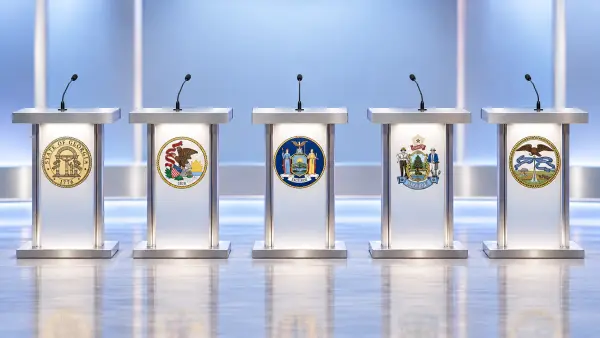
Five governor’s races produced debates between October 12 and 14 that showed how differently candidates treat the format. Georgia’s Republican nominee skipped his debate and left his opponent alone on stage, Illinois’s two candidates talked over each other for an hour, and New York’s Kathy Hochul and Bruce Blakeman fought over an ICE shooting and Donald Trump. Maine’s three candidates closed a four-debate run, and Iowa’s Rob Sand and Zach Lahn set aside the personal attacks that marked their first meeting. This dispatch covers what each candidate said, which claims could be checked and how the coverage framed each night.
Georgia: A Debate With One Candidate
Democrat Keisha Lance Bottoms appeared alone at the Atlanta Press Club’s Loudermilk-Young Governors Debate in Atlanta on October 12 after Republican Rick Jackson declined to attend. WABE reported that Jackson is the first general-election gubernatorial candidate to skip the series since 1994, and that he toured the state with Gov. Brian Kemp instead. Bottoms’s half-hour segment was televised statewide.
Jackson defended the decision by saying voters care about affordability, gas prices and property taxes. The Atlanta Journal-Constitution quoted him saying, “My priority is what Georgians want.” He and Bottoms had already shared a stage the week before at a town hall-style debate moderated by Atlanta News First’s Rick Folbaum, which organizers expected to be their only meeting.
Bottoms used the time to lay out a platform: Medicaid expansion, fully funded pre-K and a fund for affordable and workforce housing. She said she would pay for it by scrapping Kemp’s Pathways health care program, reviewing state contracts and reconsidering data center tax breaks. Moderators pressed her on rising violent crime and on crises from her years as Atlanta’s mayor, and she answered that she made the decisions she believed were right.
The most pointed moment came on abortion. Bottoms cited Jackson’s summer comments about Georgia’s six-week ban, in which he said a doctor would need evidence to avoid legal consequences, and asked the empty podium how a person would prove rape to obtain an abortion. Jackson’s campaign calls her account a mischaracterization. After the debate she called Jackson a “coward,” and she said he was prepping his outfit for a Trump rally in Georgia instead of debating.
Fact-check: This article could not locate Jackson’s original comments on the six-week ban, so it cannot say whether Bottoms’s account or his campaign’s response is accurate. Jackson’s statement that voters care more about affordability than debates is his own characterization, and no polling on that point was found. Bottoms’s funding plan was not costed in the reports read here.
Coverage: Headlines centered on the empty lectern, and the most-quoted lines came from Bottoms rather than from a contested exchange. Our Georgia governor briefing covers the race itself. Early voting began the next day, October 13.
Illinois: Interruptions, a Drinking Joke and the Bears
Gov. JB Pritzker and Republican Darren Bailey met on October 13 in WTTW News’s hourlong forum in Chicago, their only scheduled debate and a rematch of 2022. WBEZ reported that Pritzker won that earlier race by nearly 13 points, and that WTTW left independent Collin Corbett off the stage because of his poll numbers. Corbett criticized the exclusion afterward and said Illinois has become less affordable.
Bailey opened by telling viewers to drink something, non-alcoholic by his own later description, each time Pritzker mentioned Trump. Pritzker did so often, tying Bailey to Medicaid and SNAP cuts and higher diesel costs, and arguing that Bailey has cheered the policies on. Bailey replied by pointing to Indiana’s stronger pension system, and Pritzker said Bailey seemed to love Indiana more than Illinois.
Public safety was the sharpest policy fight. Bailey called for repealing the SAFE-T Act, which ended cash bail, while Pritzker defended letting judges and prosecutors decide who is released. Bailey cited the deaths of Sheridan Gorman and Katie Abraham, and Pritzker accused him of exploiting people’s pain. Prosecutors say the suspects in those cases were a Venezuelan man in the country without documentation and a Guatemalan man without legal status.
The Chicago Bears and data centers rounded out the night. Pritzker said a team valued at $9 billion does not need taxpayer help building a stadium, though he supports infrastructure aid and expects a bill in next month’s veto session. Bailey said the team is headed to Indiana and that Indiana’s governor had assured him of this. On data centers, Bailey blamed Pritzker’s tax breaks for rising energy prices, and Pritzker said he has paused state incentives and would allow new projects only if they bring their own clean energy and closed-loop water systems. Our report on Republican reversals on data centers shows how widely that issue has moved.
Fact-check: This article could not verify Bailey’s account of an assurance from Indiana’s governor, and WBEZ did not either. Bailey’s link between state tax breaks and energy prices and Pritzker’s description of his own incentive pause are also unverified here. This article could not locate a current public poll of the race.
Coverage: Headlines in the Related Links below emphasized interruptions and the drinking joke. Pritzker’s repeated Trump references and Bailey’s mockery of them were the most quoted exchange of the night.
New York: Trump, an ICE Shooting and a Contested Ranking
NY1 hosted the only scheduled debate between Hochul and Blakeman, the Nassau County executive, on October 13 at its Manhattan studios, with Susan Arbetter moderating. amNY reported that Blakeman had appeared with Trump at a Syracuse rally four days earlier, and that Hochul spent her single cross-examination question pressing him on calling Trump the greatest president of his lifetime. Blakeman answered that rally talk is meant to get a crowd worked up, then named Dwight Eisenhower, and Hochul’s team said he had walked back his own talking point.
That exchange fit the race’s polling backdrop. A Siena poll from September 23 found 51% of likely voters said Trump’s endorsement would hurt Blakeman and 30% said it would help, while 50% said Mayor Zohran Mamdani’s endorsement would help Hochul and 30% said it would hurt, per amNY. La Voce di New York reported that Hochul’s lead has narrowed to three points, down from double digits, though it did not name the poll.
Immigration was the sharpest clash. Last week an ICE agent shot a driver with a five-year-old in the back seat in the Bronx, and Hochul called ICE “out of control” and tied Blakeman to its mass deportation push. Blakeman blamed Hochul’s sanctuary policies and said Nassau County’s cooperation with federal authorities meant it had no incidents, and amNY reported that Hochul said he had refused to condemn the shooting. Hochul cited a man who died in Nassau custody, where ICE says alcohol poisoning was the cause and the man’s family disputes that.
The two also argued over crime and costs. Blakeman blamed cashless bail, Raise the Age and the HALT Act, while Hochul pointed to falling shootings and murders and about $4 billion in public safety investment. Blakeman promised to cut utility bills in half, proposed fracking in the Marcellus Shale and called solar projects a scam, while Hochul blamed Trump, tariffs and the war with Iran for higher costs and defended a one-year pause on large data center permits. Our report on New York’s data center moratorium is related background. Moderator questions also pressed Blakeman on reported remarks to Hasidic leaders about Mamdani, which he said referred to professional protesters.
Fact-check: Blakeman repeatedly said New York ranks last among the states in economic outlook without naming a source, and La Voce di New York found one matching report, the American Legislative Exchange Council’s annual ranking. This article could not verify the ranking. Hochul’s claim of a ten-year high in violent crime in Nassau County and Blakeman’s counterclaim that a U.S. News ranking names Nassau the safest county in America were both reported as claims, and this article could not check either. La Voce also noted that most illegal drugs enter through legal ports of entry, which bears on Blakeman’s fentanyl claim.
Coverage: Both campaigns claimed victory, per amNY. Coverage split between outlets that led with Blakeman’s softened Trump praise and outlets that led with the ICE shooting.
Maine: Two Closing Debates and Little Movement
Maine’s gubernatorial candidates debated twice in two days, completing a four-debate run. On October 13, CBS 13 and FOX 23 hosted Democrat Hannah Pingree, Republican Bobby Charles and independent Rick Bennett, and housing dominated. FOX 23 reported that Pingree proposed $100 million a year for housing production, a goal of 80,000 units by 2030, a 90-day permitting deadline and limits on private equity buying affordable housing.
Charles called her plan inadequate, saying Mainers do not need “a 250 house answer to a $30 billion problem,” and proposed cutting builder regulations, first-time buyer tax incentives and faster permitting. Bennett proposed lower down payments, direct mortgage support, revived factory-built housing and a statewide audit of approval bottlenecks. On spending, Charles and Bennett said the state should cut, while Pingree said federal cuts to Medicaid, schools and public health leave leaders no choice but to spend more.
The final debate came on October 14, hosted by WMTW. Central Maine reported that it had no major moments and mostly repeated earlier positions. Charles again tied Pingree to Gov. Janet Mills over energy and housing costs and called both Pingree and Bennett insiders, while Pingree briefly criticized Bennett as a lifelong Republican who chaired the state party from 2013 to 2017. Bennett cited his votes against Republican proposals as a state senator, Charles noted that Bennett took a Democratic ballot in June, and Bennett repeated that “My jersey says Maine.”
The same report said Pingree has consistently led polling by double digits, with Bennett’s path described as very narrow. Fundraising gaps are large: more than $4.2 million for Pingree, more than $1.8 million for Charles and about $923,000 for Bennett. A PAC formed by Republican donors to back Charles has spent about $70,000 boosting Bennett instead.
Fact-check: The $100 million, 80,000-unit and $30 billion figures are candidate proposals or estimates, and this article could not verify them. The outlet’s account of the Mills administration’s housing record, $350 million over eight years including 7,500 new units last year, was reported as context and not checked here. Central Maine gave no pollster, numbers or dates for its polling statement, and this article could not locate the underlying polls. Central Maine also described the WMTW debate as Thursday evening, while schedules listed it for Wednesday, October 14.
Coverage: Headlines described the final debate as unremarkable, and the more interesting storyline was Bennett’s independent bid and whether national Republican money reaches Charles. For related trade context, see the outside-US section below.
Iowa: A Calmer Second Debate After a Personal First
The first Iowa debate on October 6 in Davenport was dominated by residency and family wealth. PolitiFact checked Sand’s claim that Lahn voted in Kansas in 2018, 2020 and 2022 and rated it accurate, and it rated Lahn’s claim of $7,500 in annual savings for a family of four from tax changes false, estimating about $3,500 on average. Lahn’s claim that Sand’s family money came from selling high-nitrate fertilizer got a needs-context verdict.
The second debate on October 14, hosted by KTIV in Sioux City, ran on policy. KTIV reported that the candidates discussed their running mates, with Lahn defending Derek Wulf, who has faced at least five lawsuits this year tied to his farm according to court records. Sand described his pick, Dave Muhlbauer, as a family farmer who could win election as a county supervisor in a Republican-majority county.
School funding and the budget split them. Sand proposed a 5% increase in state aid in his first year but would not promise it for a second, and The Daily Iowan reported that he cited a $1.3 billion annual deficit against a roughly $9.5 billion budget. His proposals included taxing recreational cannabis, ending data center tax breaks and requiring local governments to use the state auditor’s efficiency program. Lahn declined to name a funding percentage, proposed eliminating property taxes on primary single-family residences and defended education savings accounts, saying, “I don’t think it’s a welfare program.”
They found common ground on a goal of sourcing 80% of school lunches from Iowa farms. They split on H-1B visas, with Lahn favoring a ban on them for public universities and government jobs and Sand opposing closing the door to workers from elsewhere. A proposed $15 billion steel mill in southeast Iowa also anchored the workforce discussion, and our Iowa governor briefing covers the race.
Fact-check: Sand’s $1.3 billion deficit and school-ranking claims were not sourced in the report read here, and this article could not verify them. Lahn’s property-tax elimination and real-time government transaction proposals came without cost estimates. This article could not open the Iowa Capital Dispatch report of the second debate, so details beyond KTIV and The Daily Iowan are not included.
Coverage: Headlines in the Related Links below describe the second debate as more cordial and as putting personal attacks aside, a contrast with the first debate’s residency fight.
View from Outside the US
The Maine and Iowa debates connect to two issues that draw attention abroad. A Reuters report carried by BNN Bloomberg said Canada accounted for 69% of Maine’s imports and 41% of its exports in 2025, and that Canada’s retaliatory tariffs of 15% to 50% on about $20 billion of US goods took effect September 8. Those figures help explain why Charles and Bennett both stress housing and energy costs, though the Maine debate reports read here did not describe trade with Canada as a major topic. Our Canada tariffs report covers the wider effect.
On H-1B visas, Indian outlets have followed US policy closely since September 2025, when Careers360 reported a $100,000 fee proclamation for new H-1B petitions and quoted the IIT Madras director calling it a “blessing in disguise.” This article could not verify the fee’s current status in October 2026. Lahn’s proposal is narrower than that federal action, applying to public universities and government jobs.
Note on Scope
This dispatch relies on published reports rather than full transcripts or video, so word choices and some figures are as reported. Reporting is current as of October 15, 2026. The Georgia event was a solo forum rather than a two-candidate debate, and it is included because of what its format revealed. The five races were chosen for unusual format or notable moments, and several other governor debates in the period, including Oregon’s October 13 meeting between Tina Kotek and Christine Drazan, were not covered. This article could not open reports from Capitol News Illinois, Gothamist, Maine Morning Star or the Iowa Capital Dispatch’s second-debate coverage. No social media reaction attributed through a named outlet was found, and this article does not judge who won any debate.
Related Links
- WTOC: Biggest moments in Georgia’s first governor debate
- NPR Illinois: 6 takeaways from the Pritzker-Bailey debate
- ABC7 Chicago: Pritzker and Bailey clash early in only debate
- Maine Public: This week is stacked with debates
- Maine Morning Star: Key takeaways from the final governor debate
- Iowa Public Radio: Lahn and Sand hold first debate
- Second governor debate is more cordial after heated first outing
Discussion Questions
- Have you ever watched a political debate? How did it affect your view of the candidates?
- Should a candidate who skips a debate be penalized by voters, or is that a fair campaign choice?
- Is a debate with only one candidate still useful to voters? Why or why not?
- Does mocking an opponent, like the Trump drinking joke in Illinois, help or hurt a candidate?
- Should debate organizers exclude independent candidates based on poll numbers?
- Why might a candidate soften praise of a party leader during a general election campaign?
- How should voters judge a claim, like New York’s economic ranking, when the source is hard to find?
- Why do second debates sometimes become calmer than the first, as in Iowa?
- What matters more when you choose a governor: the budget plan or the candidate’s character?
- Imagine you are a debate moderator. What three questions would you ask the candidates in your state’s governor race?
