
Reading
In July 2026, President Donald Trump said he had left instructions for the US military to strike Iran “at levels that they’ve never seen before” if Iran were to assassinate him. He repeated the idea on social media, writing that missiles were ready and that orders had already been given for a set period of time. The remarks followed reports of a possible Iranian plot against him and rising tension after the death of Iran’s supreme leader earlier in the year.
It is worth separating what is confirmed from what is not. Trump did make these public statements; that part is verifiable. But the claim that a binding, automatic order exists, one that would launch an attack by itself after his death, is unsubstantiated. The White House did not confirm the details, and legal analysts noted that the United States has no automatic “dead man’s switch” for retaliation. If a president dies, power passes immediately to the next person in line under the Twenty-Fifth Amendment and the Presidential Succession Act. Any decision to use force would then belong to the new commander-in-chief, most likely the vice president, not to a pre-recorded instruction from the person who died. This is a useful entry point into a bigger question that matters far beyond one president: who actually commands the US military, and what are soldiers required to do when they receive an order?
The starting point is the Constitution. Article II names the president the commander-in-chief of the armed forces. This makes the top military commander a civilian, an elected official rather than a general. The framers designed it this way on purpose, to keep the military under the control of elected government. This principle is called civilian control of the military. Alexander Hamilton described the role as the supreme command and direction of the forces, not a power to do anything the president wishes.
The president does not hold war powers alone. Article I gives Congress the power to declare war, to fund the military, and to make the rules that govern it. This division is deliberate: one branch directs the forces, another authorizes and pays for their use. In practice, the balance has shifted over time. Congress has not formally declared war since 1942. Instead it often passes an Authorization for Use of Military Force, a law that lets the president use the military within certain limits. Presidents have also ordered military action on their own, citing their authority to respond to threats, and the exact boundary between the two branches remains contested.
One tool Congress created to limit the president is the War Powers Resolution of 1973. It requires the president to notify Congress within 48 hours of sending forces into hostilities and bars them from staying longer than about 60 days without congressional approval. Presidents from both parties have argued the resolution is unconstitutional and have often acted around it, and courts have generally declined to settle the dispute. So the law exists, but its practical force is limited.
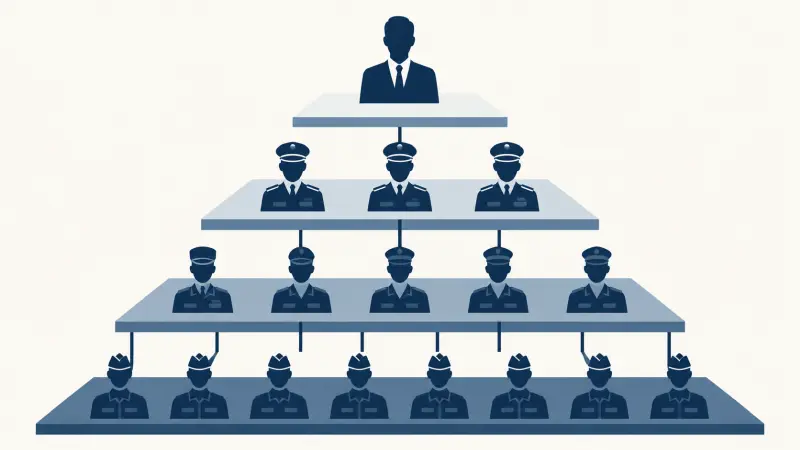
Below the president, authority flows down a chain of command, an ordered line of officers through which orders pass from the top to the individual service member. Each person answers to the one above them. This structure lets a large force act quickly and in a coordinated way. But following orders is not unconditional. Military law draws a firm line between orders that must be obeyed and orders that must be refused.
The rules come from the Uniform Code of Military Justice, the body of federal law that governs the armed forces. Under it, service members have a legal duty to obey a lawful order. Refusing one can bring serious punishment, including a court-martial, the military’s own criminal trial. At the same time, service members have a duty to refuse an unlawful order. An order is unlawful when it requires a crime or violates the Constitution, US law, or international law. The clearest examples are orders to kill civilians, torture prisoners, or falsify official records.
Here the standard becomes demanding. Every order is treated as lawful unless it is manifestly illegal, meaning its illegality is clear and obvious on its face. A service member who obeys a manifestly illegal order is still responsible for the crime; “I was just following orders” is not a defense, a principle established after the Second World War and reinforced by the My Lai prosecutions from the Vietnam War. But a service member who refuses an order that is later judged lawful can be punished for disobedience. The person receiving the order carries the burden of proof to show the order was clearly illegal, and that judgment is usually made after the fact by a military court.
This creates real pressure in the moment. Most operational orders are not obviously illegal, and hesitation carries risk. Legal guides advise service members who are unsure to seek advice from a military lawyer, known as a Judge Advocate, and to raise concerns through official channels rather than simply refusing. The system is built to run on obedience, with refusal reserved for the plainly criminal case.
Where People Disagree
Beneath these rules sit genuine debates. The first is about how much power the commander-in-chief should have. One view holds that modern threats, from terrorism to missiles, demand a president who can act fast, decisively, and without waiting for a slow legislature. The opposing view holds that the framers gave the president the title mainly to preserve civilian control, not to allow war-making alone, and that Congress should authorize serious military action. Both sides point to the same Constitution and read it differently.
A second debate concerns the manifestly illegal standard. Supporters say a high bar is necessary, because a military in which any soldier could refuse any order they personally doubted would not function. Critics say the bar is so high, and the risk of refusing so great, that it offers weak protection when a questionable order is not obviously criminal. The recent public discussion of domestic troop deployments, where courts later found some orders unlawful, has sharpened this disagreement.
A third question is whether any single official can guarantee a specific military outcome in advance, as the opening story implied. Because command passes to a living successor and because unlawful orders must be refused, most legal analysts describe an automatic, self-executing attack order as inconsistent with how US command actually works. Whether that legal design is reassuring or too dependent on individual judgment is itself a matter of opinion.
Glossary
commander-in-chief (noun) — the person with supreme command of a country’s armed forces; in the US, the president.
Translations: 总司令 | 最高司令官 | 총사령관 | सर्वोच्च सेनापति | القائد الأعلى | главнокомандующий | comandante en jefe | commandant en chef
- The Constitution makes the president the commander-in-chief of the armed forces.
- As commander-in-chief, the president gives direction to the military but does not act entirely alone.
civilian control of the military (noun phrase) — the principle that elected, non-military leaders hold ultimate authority over the armed forces.
Translations: 文官控制军队 | 文民統制 | 군에 대한 문민 통제 | सेना पर नागरिक नियंत्रण | السيطرة المدنية على الجيش | гражданский контроль над армией | control civil del ejército | contrôle civil de l’armée
- Placing a civilian at the top ensures civilian control of the military.
- Civilian control of the military keeps the armed forces answerable to elected government.
civilian (noun) — a person who is not a member of the armed forces.
Translations: 平民 | 民間人 | 민간인 | नागरिक | مدني | гражданское лицо | civil | civil
- The president is a civilian, not a serving general.
- Orders to deliberately harm civilians are treated as unlawful.
chain of command (noun phrase) — the ordered line of authority through which orders pass from senior to junior members.
Translations: 指挥系统 | 指揮系統 | 지휘 계통 | कमान की श्रृंखला | التسلسل القيادي | цепочка командования | cadena de mando | chaîne de commandement
- Orders move down the chain of command from the president to each unit.
- Every service member answers to someone above them in the chain of command.
Constitution (noun) — the fundamental law of the United States that defines the powers of government.
Translations: 宪法 | 憲法 | 헌법 | संविधान | الدستور | конституция | constitución | constitution
- The Constitution divides war powers between the president and Congress.
- An order that violates the Constitution is not lawful.
Congress (noun) — the legislative branch of the US government, made up of the Senate and the House of Representatives.
Translations: 国会 | 連邦議会 | 의회 | कांग्रेस | الكونغرس | конгресс | Congreso | Congrès
- Congress has the power to declare war and to fund the military.
- The president must notify Congress when sending forces into hostilities.
declare war (verb phrase) — to formally announce, through the branch of government with that power, that a state of war exists.
Translations: 宣战 | 宣戦布告する | 전쟁을 선포하다 | युद्ध की घोषणा करना | إعلان الحرب | объявить войну | declarar la guerra | déclarer la guerre
- Only Congress can declare war under the Constitution.
- The United States has not formally declared war since 1942.
Authorization for Use of Military Force (noun phrase) — a law passed by Congress allowing the president to use the military within stated limits, short of a formal war declaration.
Translations: 使用武力授权 | 武力行使容認決議 | 무력 사용 승인 | सैन्य बल प्रयोग की अनुमति | تفويض استخدام القوة العسكرية | разрешение на применение военной силы | autorización para el uso de la fuerza militar | autorisation de recours à la force militaire
- Congress often passes an Authorization for Use of Military Force instead of declaring war.
- An Authorization for Use of Military Force can be read broadly or narrowly.
War Powers Resolution (noun) — a 1973 US law that limits how long a president can keep forces in hostilities without congressional approval.
Translations: 战争权力决议 | 戦争権限法 | 전쟁 권한 결의 | युद्ध शक्ति संकल्प | قرار صلاحيات الحرب | резолюция о военных полномочиях | Resolución de Poderes de Guerra | résolution sur les pouvoirs de guerre
- The War Powers Resolution requires the president to notify Congress within 48 hours.
- Presidents have often argued the War Powers Resolution is unconstitutional.
Uniform Code of Military Justice (noun) — the federal law that sets the rules and criminal offenses for members of the US armed forces.
Translations: 军事司法统一法典 | 統一軍事裁判法 | 군사 통일 법전 | समान सैन्य न्याय संहिता | القانون الموحد للقضاء العسكري | Единый кодекс военной юстиции | Código Uniforme de Justicia Militar | Code uniforme de justice militaire
- The Uniform Code of Military Justice creates the duty to obey lawful orders.
- Refusing a lawful order can be punished under the Uniform Code of Military Justice.
lawful order (noun phrase) — an order that a service member has a legal duty to obey because it does not violate law.
Translations: 合法命令 | 合法な命令 | 합법적 명령 | वैध आदेश | أمر قانوني | законный приказ | orden legal | ordre légal
- A service member must obey a lawful order.
- Most operational instructions count as a lawful order.
unlawful order (noun phrase) — an order that requires a crime or violates the Constitution, US law, or international law.
Translations: 非法命令 | 違法な命令 | 불법적 명령 | अवैध आदेश | أمر غير قانوني | незаконный приказ | orden ilegal | ordre illégal
- A service member has a duty to refuse an unlawful order.
- Obeying an unlawful order does not remove personal responsibility.
manifestly illegal (adjective phrase) — clearly and obviously illegal on its face, with no reasonable doubt.
Translations: 明显违法 | 明白に違法 | 명백히 위법한 | स्पष्ट रूप से अवैध | غير قانوني بشكل واضح | явно незаконный | manifiestamente ilegal | manifestement illégal
- An order to shoot unarmed civilians is manifestly illegal.
- The order must be manifestly illegal before refusal is clearly protected.
court-martial (noun) — a military court that tries members of the armed forces for offenses under military law.
Translations: 军事法庭 | 軍法会議 | 군사 법원 | सैन्य अदालत | محكمة عسكرية | военный трибунал | consejo de guerra | cour martiale
- Disobeying a lawful order can lead to a court-martial.
- A military judge at a court-martial decides whether an order was lawful.
burden of proof (noun phrase) — the responsibility to prove a claim; here, the duty to show an order was unlawful.
Translations: 举证责任 | 立証責任 | 입증 책임 | प्रमाण का भार | عبء الإثبات | бремя доказывания | carga de la prueba | charge de la preuve
- The service member carries the burden of proof that an order was illegal.
- A heavy burden of proof makes refusal legally risky.
Judge Advocate (noun) — a military lawyer who advises service members and commands on legal questions.
Translations: 军法官 | 法務官 | 군 법무관 | न्यायाधिकारी | المستشار القانوني العسكري | военный юрист | asesor jurídico militar | conseiller juridique militaire
- A service member in doubt can consult a Judge Advocate.
- The Judge Advocate can explain whether an order appears lawful.
Twenty-Fifth Amendment (noun) — the constitutional amendment that governs presidential succession and the transfer of power.
Translations: 第二十五修正案 | 憲法修正第25条 | 수정헌법 제25조 | पच्चीसवाँ संशोधन | التعديل الخامس والعشرون | Двадцать пятая поправка | Vigesimoquinta Enmienda | vingt-cinquième amendement
- The Twenty-Fifth Amendment transfers power to the vice president if the president dies.
- Under the Twenty-Fifth Amendment, command does not disappear when a president is gone.
My Lai (proper noun) — a 1968 massacre of unarmed Vietnamese civilians by US soldiers, later used to establish that obeying an illegal order is not a defense.
Translations: 美莱 | ソンミ | 미라이 | माई लाई | ماي لاي | Милай | My Lai | My Lai
- The My Lai case showed that following orders does not excuse a war crime.
- After My Lai, courts reinforced the duty to refuse manifestly illegal orders.
Discussion Questions
- Before reading this, how did you think decisions to use the military were made?
- Why do you think the framers wanted a civilian, not a general, at the top of the military?
- Do you find the case for a strong, fast-acting commander-in-chief or the case for congressional approval more convincing?
- Should one leader be able to decide alone to use military force? Why or why not?
- What are the risks of a chain of command that runs mostly on obedience?
- What are the risks of letting individual soldiers decide which orders to follow?
- The reading says an order must be “manifestly illegal” before refusal is clearly protected. Is that bar too high, too low, or about right?
- Why might a soldier obey an order they suspect is wrong, even at personal cost?
- How should a country treat a soldier who refuses an order they believe is illegal but is later judged lawful?
- Does your country place clear limits on who can order the use of force? How do they compare?
- Why do you think formal declarations of war have become so rare in the US?
- Imagine you are a young officer who receives an order you believe may be unlawful. What would you do, and what would you weigh?
Related Links
- Commander in Chief powers (Legal Information Institute, Cornell Law School)
- War powers overview (Legal Information Institute, Cornell Law School)
- Interpretation: Commander in Chief Clause (National Constitution Center, with competing viewpoints)
- Power to Declare War (US House of Representatives, History, Art & Archives)
- Orders: lawful and illegal, on the duty to obey and refuse (military defense law firm)
- A close reading of the UCMJ and disobedience (Lawfare)
- Trump suggests a standing order to attack Iran; succession would decide (The Washington Post)
