
What Happened
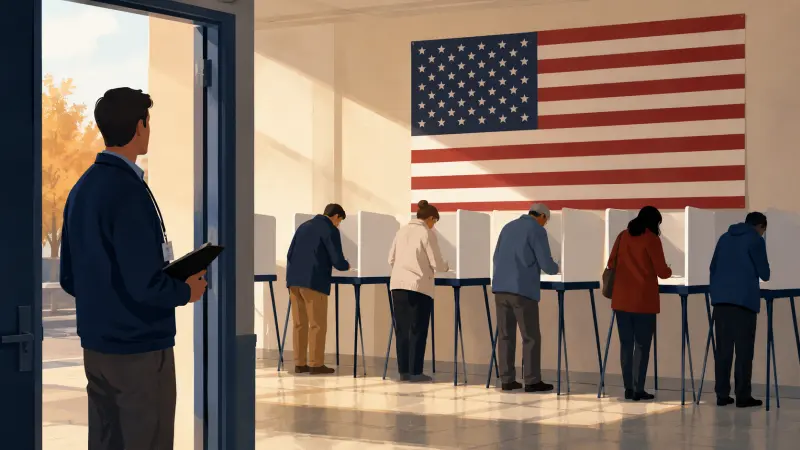
In the final week of June 2026, the U.S. Department of Justice sent letters to officials in three Michigan cities, Detroit, Lansing, and East Lansing, notifying them that federal election monitors will be deployed to polling locations during the state’s August 4 primary. The letters also requested election-related documents from each city. All three cities lean strongly Democratic.
The letters cited specific concerns from the 2024 general election, including allegations of long lines, an insufficient supply of provisional ballots, and problems with Voter Accessible Terminals (machines that let voters with disabilities cast a private, independent ballot). The letter to Lansing, dated June 23, went further, claiming Lansing officials did not use Michigan’s statewide qualified voter file as the official registration list at polling places in 2024.
Michigan Secretary of State Jocelyn Benson and Attorney General Dana Nessel publicly responded on July 6, calling the DOJ’s justifications baseless. Local officials disputed the specific claims in the letters. Ingham County Clerk Barb Byrum, whose jurisdiction includes Lansing and East Lansing, called the claim about the qualified voter file “patently false,” saying the file is used at every Michigan election as required by law.
Background
This is not the DOJ’s first move toward federal involvement in Michigan’s 2026 elections. In a letter dated November 13, 2025, 22 Republican state legislators, including Senate Minority Leader Aric Nesbitt and former Secretary of State Ruth Johnson, asked U.S. Attorney General Pam Bondi to provide “comprehensive oversight” of Michigan’s 2026 election. That letter did not specify what “comprehensive oversight” would mean in practice.
The Republican letter raised several claims about Secretary of State Benson’s administration of elections, including that Michigan’s voter rolls contained close to 26,000 deceased registrants, that at least 16 noncitizens voted in the 2024 general election, and that Michigan received a “D” grade for election integrity from an outside review. Benson is also a declared candidate for Michigan governor in 2026, which Republicans cited as a reason for outside oversight of the office she runs.
Federal election monitoring itself is not new or inherently partisan. Under the Voting Rights Act, the DOJ has long had authority to send observers to watch polling places, and administrations of both parties have used this authority in select jurisdictions. What is contested here is not whether the DOJ can send monitors, but whether the specific factual claims used to justify doing so in these three cities are accurate, and whether the choice of three Democratic-leaning cities reflects genuine, evidence-based concerns or a politically targeted effort.
What Different Sides Are Saying
DOJ and Michigan Republicans argue that Michigan’s election administration under Benson has shown a pattern of problems serious enough to warrant direct federal observation in these specific cities.
Claim: Lansing did not use the statewide qualified voter file as its official polling-place registration list in 2024. Fact check: This is directly disputed by local officials with firsthand knowledge. Ingham County Clerk Barb Byrum said the claim is false and that the qualified voter file is used at every Michigan election. The DOJ has not made the underlying evidence for its claim public. This is a direct factual contradiction between the two sides that cannot be independently resolved from public reporting alone.
Claim: Nearly 26,000 deceased voters remained on Michigan’s rolls. Fact check: This figure originated in a lawsuit filed by the Public Interest Legal Foundation. A federal district court dismissed the suit, finding that “the record demonstrates that deceased voters are removed from Michigan’s voter rolls on a regular and ongoing basis.” The Sixth Circuit Court of Appeals upheld that dismissal, and the U.S. Supreme Court declined to hear a further appeal in March 2026, leaving the dismissal in place. Some lag between a voter’s death and their removal from the rolls is normal and expected in every state; the courts found no evidence Michigan’s process was unusually slow or negligent.
Claim: At least 16 noncitizens voted in the 2024 general election. Fact check: This is accurate and was confirmed by Michigan’s own Secretary of State’s office following an April 2025 review. Thirteen of the 16 cases were referred to the state Attorney General’s office. For context, this represents roughly 0.00028 percent of the approximately 5.7 million votes cast in Michigan in that election. Benson has described noncitizen voting as rare but real, saying it should be addressed “with a scalpel, not a sledgehammer.”
Claim: Michigan received a “D” grade for election integrity. Fact check: We could not independently verify the source or methodology of this specific grade from public reporting. Election-integrity “report cards” are typically produced by advocacy organizations rather than nonpartisan government bodies, and grades can vary widely depending on the criteria and political leanings of the group issuing them. Readers should treat this claim with caution until its source is confirmed.
Michigan state and local officials argue that the DOJ’s stated justifications do not hold up and that the effort amounts to federal overreach into a process the Constitution assigns primarily to the states.
Claim: “States run elections, not the federal government.” Fact check: This is a legal framing rather than a pure factual claim. The Constitution’s Elections Clause does give states the primary role in administering elections, but Congress and the DOJ have established legal authority under the Voting Rights Act to send federal observers to monitor for compliance with federal law. So the claim is accurate as a general principle of primary state authority, but it somewhat understates the federal government’s established, narrower observation role.
Claim: Federal monitors do not have authority to interfere with election administration or demand unrestricted access to voting equipment. Fact check: This is accurate. Federal election observers under the Voting Rights Act are authorized to observe but must follow applicable state and local election laws and cannot direct how an election is run.
Related Links
- DOJ says it will send election monitors to 3 Michigan cities, The Detroit News
- DOJ to send election monitors to Detroit, Lansing, East Lansing, Bridge Michigan
- AG Nessel, Secretary Benson Respond to DOJ Primary Election Municipal Letters, Michigan Attorney General
- Local officials push back on DOJ’s plan, WILX
- GOP seeks federal oversight of Michigan’s 2026 election, Votebeat
- Michigan election review finds 16 non-citizens likely voted in 2024, Michigan Public Radio
- Supreme Court declines to hear twice-dismissed case on Michigan voter rolls, Michigan Advance
Discussion Questions
- Have you or someone you know ever seen an election observer at a polling place?
- Do federal election monitors make you more or less confident in an election’s results?
- Which claim in the DOJ’s letters do you find most convincing, and why?
- Do you find the Ingham County Clerk’s denial or the DOJ’s letter more credible on the qualified voter file issue?
- Why do disputes over “who runs elections” keep coming up in American politics?
- Should the federal government have a bigger or smaller role in overseeing state elections?
- How might sending monitors only to Democratic-leaning cities affect public perception of the effort?
- What would convince you that noncitizen voting is a serious problem rather than a rare occurrence?
- How should officials respond to isolated cases of fraud without undermining trust in elections overall?
- Imagine you are a poll worker in Detroit, Lansing, or East Lansing on primary day. How would a federal monitor’s presence change how you do your job?
