
Reading
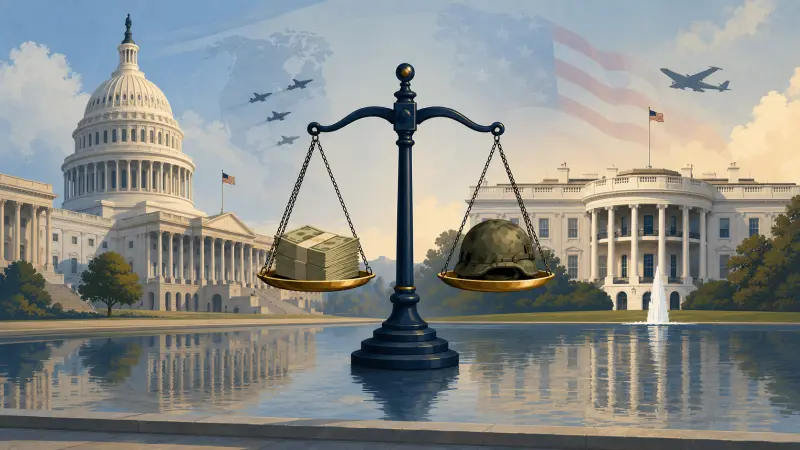
The United States Constitution divides authority over the military between two branches of government. Article I gives Congress the power to declare war and to control military funding through appropriations. Article II makes the president the commander in chief of the armed forces, responsible for directing operations once forces are committed. This split is meant to be part of the system of checks and balances built into the Constitution, in which each branch limits the powers of the others. For most of the nation’s history, the split has been a source of tension rather than a clear division of labor.
Since World War II, presidents have ordered the deployment of US forces into hostilities dozens of times without a formal declaration of war from Congress. This became especially controversial during the Vietnam War, when reporting revealed that President Richard Nixon had ordered secret bombing campaigns in Cambodia without informing lawmakers. In response, Congress passed the War Powers Resolution in 1973. Nixon vetoed the bill, arguing it was an unconstitutional restriction on presidential authority, but both chambers of Congress overrode the veto by the required two-thirds majority, and it became law.
The War Powers Resolution requires the president to send a formal notification to Congress within 48 hours of introducing US forces into hostilities. It then gives Congress 60 days, with a possible 30-day extension for withdrawal, to either declare war, pass a specific congressional authorization for the action, or require the president to stop. In practice, presidents from both parties have questioned whether the law is constitutional, arguing it interferes with the executive branch‘s authority as commander in chief. Many administrations have sent the required notifications while not fully complying with the withdrawal clock. The law has never been tested by a final Supreme Court ruling, in part because courts have often treated war powers disputes as political questions better resolved between Congress and the president than by judges.
This debate has renewed relevance in 2026. After the United States and Israel launched large-scale strikes on Iranian military targets in late February, US forces carried out repeated rounds of strikes against Iran through the year, including strikes in July on transportation infrastructure inside Iranian territory. No lasting ceasefire has held for long. In June, both the House and the Senate passed war powers resolutions directing the president to end hostilities with Iran unless Congress specifically authorized continued action. The Senate resolution passed 50 to 48, with four Republican senators joining Democrats. Because the resolution did not have a veto-proof majority, and the administration disputed that it was legally required to stop, US strikes on Iran continued into July. This illustrates a long-standing feature of the law: it can pass Congress and still not change what happens on the ground, since it lacks a fast enforcement mechanism if the president disagrees with how it applies.
The disagreement reflects two different views of the founders’ design that remain contested today. One view holds that Congress, as the legislative branch, was deliberately given the sole power to start a war because the framers feared a single leader could draw the country into conflict without public debate or accountability. Under this view, the War Powers Resolution simply restates what the Constitution already requires, and modern conflicts fought without specific authorization are constitutionally questionable regardless of which party holds the presidency. The other view holds that modern warfare, including fast-moving strikes, requires a president to act with speed that a 535 member Congress cannot provide, and that Congress’s real check is its power over funding, not a statute passed during a uniquely low point in presidential credibility after Vietnam and Watergate. Neither view has been definitively settled by the courts.
Supporters of a stronger congressional role point to a consistent, bipartisan pattern across decades, in disputes involving Lebanon, Grenada, Kosovo, Libya, and now Iran, of presidents acting first and Congress objecting afterward. Defenders of executive flexibility respond that Congress has always had the power to cut off funding for any of these operations and rarely uses it, suggesting that war powers votes, including the 2026 Iran resolutions, function more as symbolic statements of disapproval than as binding limits, since a resolution alone does not carry the force of law the way a bill signed by the president, or passed over a veto, does. Whether a unilateral military action by a president should be treated as a precedent for future presidents, or as an isolated case tied to specific facts, is itself part of the ongoing debate.
What is not in dispute is the basic mechanic: a use of force is supposed to trigger notification, and a clock starts. What remains unsettled, more than 50 years after the law’s passage, is what happens when the president and Congress disagree about whether that clock requires troops to come home, and who, if anyone, can force the issue.
Glossary
declare war (verb phrase) — to officially state that a country is beginning a war, usually through a formal act of the legislature.
Translations: 宣战 | 宣戦布告する | 선전포고하다 | युद्ध की घोषणा करना | إعلان الحرب | объявлять войну | declarar la guerra | déclarer la guerre
- Only Congress has the constitutional power to declare war.
- The United States has not formally used its power to declare war since World War II.
commander in chief (noun) — the person with supreme authority over a country’s armed forces; in the US, this is the president.
Translations: 三军统帅 | 最高司令官 | 최고 사령관 | सर्वोच्च सेनापति | القائد الأعلى | главнокомандующий | comandante en jefe | commandant en chef
- As commander in chief, the president directs military operations once troops are deployed.
- Presidents have often cited their role as commander in chief to justify acting without Congress.
hostilities (noun, plural) — acts of warfare or armed conflict between opposing forces.
Translations: 敌对行动 | 戦闘行為 | 적대 행위 | शत्रुता | أعمال عدائية | военные действия | hostilidades | hostilités
- The law requires notice within 48 hours of US forces entering hostilities.
- Lawmakers disagreed over whether the strikes counted as hostilities under the statute.
veto (verb/noun) — the power of one official or body to reject a decision made by another.
Translations: 否决 | 拒否権 | 거부권 | वीटो | حق النقض (فيتو) | вето | veto | veto
- Nixon issued a veto of the War Powers Resolution in 1973.
- A presidential veto can be overridden by a two-thirds vote in both chambers.
override (verb) — to use a greater authority to cancel or set aside a decision, such as a veto.
Translations: 推翻 | (拒否権を)覆す | (거부권을) 무효화하다 | निरस्त करना | تجاوز (الفيتو) | преодолевать (вето) | anular (un veto) | passer outre (un veto)
- Congress voted to override Nixon’s veto in November 1973.
- An override requires a two-thirds majority in the House and Senate.
resolution (noun) — a formal expression of a legislature’s opinion or decision, which may or may not carry the force of law.
Translations: 决议 | 決議 | 결의안 | प्रस्ताव | قرار | резолюция | resolución | résolution
- The Senate passed a war powers resolution calling for an end to hostilities with Iran.
- A resolution can express Congress’s will without changing the law.
congressional authorization (noun phrase) — formal permission granted by Congress for a specific government action, such as the use of military force.
Translations: 国会授权 | 議会の承認 | 의회 승인 | कांग्रेस की स्वीकृति | تفويض من الكونغرس | санкция Конгресса | autorización del Congreso | autorisation du Congrès
- Without a specific congressional authorization, the president is supposed to end the hostilities.
- Some past conflicts were carried out under broad, older congressional authorizations.
executive branch (noun) — the part of government, headed by the president, that carries out and enforces laws.
Translations: 行政部门 | 行政府 | 행정부 | कार्यपालिका | السلطة التنفيذية | исполнительная власть | poder ejecutivo | pouvoir exécutif
- The executive branch has argued the War Powers Resolution limits its constitutional authority.
- Every modern president has pushed back on some part of the executive branch‘s obligations under the law.
legislative branch (noun) — the part of government, Congress, responsible for making laws.
Translations: 立法部门 | 立法府 | 입법부 | विधायिका | السلطة التشريعية | законодательная власть | poder legislativo | pouvoir législatif
- The Constitution gives the legislative branch the power to declare war.
- Some scholars argue the legislative branch has given up too much of its war powers role over time.
checks and balances (noun phrase) — a system in which each branch of government can limit the powers of the others.
Translations: 制衡 | 抑制と均衡 | 견제와 균형 | नियंत्रण और संतुलन | الضوابط والتوازنات | система сдержек и противовесов | pesos y contrapesos | freins et contrepoids
- War powers disputes are a classic test of the system of checks and balances.
- The framers built checks and balances into the Constitution to prevent any one branch from dominating.
bipartisan (adjective) — supported by members of two opposing political parties.
Translations: 两党的 | 超党派の | 초당파적인 | द्विदलीय | ثنائي الحزب | двухпартийный | bipartidista | bipartisan
- Four Republicans joined Democrats in a bipartisan Senate vote on the Iran war powers resolution.
- War powers concerns have produced bipartisan objections across several administrations.
symbolic (adjective) — representing something meaningful without producing a direct legal or practical effect.
Translations: 象征性的 | 象徴的な | 상징적인 | प्रतीकात्मक | رمزي | символический | simbólico | symbolique
- Critics called the resolution largely symbolic, since it did not stop the strikes.
- A symbolic vote can still shape public debate even without legal force.
unilateral (adjective) — done by one party alone, without agreement from others involved.
Translations: 单方面的 | 一方的な | 일방적인 | एकतरफा | أحادي الجانب | односторонний | unilateral | unilatéral
- Critics described the continued strikes as a unilateral decision by the president.
- The law was written specifically to limit unilateral military action.
precedent (noun) — an earlier action or decision used as an example or guide for future situations.
Translations: 先例 | 前例 | 선례 | मिसाल | سابقة | прецедент | precedente | précédent
- Some lawmakers worry that inaction now sets a precedent for future presidents.
- Each unresolved dispute becomes a potential precedent, even without a court ruling.
appropriations (noun) — money that a legislature formally sets aside for a specific government purpose.
Translations: 拨款 | 歳出 | 세출 | विनियोग | مخصصات مالية | ассигнования | asignaciones presupuestarias | crédits budgétaires
- Congress could use its power over appropriations to cut off funding for a conflict.
- Some scholars see control of appropriations as Congress’s most reliable war powers tool.
deployment (noun) — the movement of military forces into position for action.
Translations: 部署 | 展開 | 배치 | तैनाती | نشر (القوات) | развертывание | despliegue | déploiement
- The deployment of additional forces to the region raised new war powers questions.
- Notification requirements apply from the moment of deployment into hostilities.
notification (noun) — a formal message informing someone of an action or decision.
Translations: 通知 | 通知 | 통보 | सूचना | إخطار | уведомление | notificación | notification
- The president must send a notification to Congress within 48 hours.
- Administrations have sometimes sent a notification without treating the rest of the law as binding.
ceasefire (noun) — an agreement to stop fighting, often temporary.
Translations: 停火 | 停戦 | 휴전 | युद्धविराम | وقف إطلاق النار | прекращение огня | alto el fuego | cessez-le-feu
- No lasting ceasefire had been reached in the Iran conflict as of this writing.
- Negotiators have discussed terms for a ceasefire several times during the conflict.
Discussion Questions
- Have you ever followed a debate in your own country about who should have the power to start a war?
- Do you think a resolution that passes Congress but is not signed by the president should still carry real weight?
- Whose argument do you find more convincing: that Congress must approve military action, or that the president needs speed and flexibility?
- Why do you think Congress rarely uses its funding power to stop a military operation it disagrees with?
- Should courts be willing to rule directly on war powers disputes, or should this stay a political question between Congress and the president?
- What risks come from letting one branch of government act largely on its own in a crisis?
- How does the history of the Vietnam War help explain why the War Powers Resolution was written the way it was?
- Do you think citizens today know enough about how their country can be brought into a war?
- What would change if stopping a military action required only a simple majority instead of a veto-proof one?
- How much should a fifty-year-old law be expected to fit conflicts involving new kinds of weapons or attacks?
- Should members of the same political party be expected to agree on war powers questions, or is disagreement here reasonable?
- Imagine you are a newly elected member of Congress. Would you vote to expand or limit the president’s power to act without your approval? Why?
Related Links
- War Powers Resolution – Wikipedia
- War Powers Resolution of 1973 – Richard Nixon Presidential Library
- In symbolic vote, Congress directs Trump to remove forces from Iran war – NPR
- House passes war powers resolution directing Trump to end hostilities with Iran – NPR
- US strikes Iran for second day: Is it a violation of war powers resolution? – Al Jazeera
- Does the War Powers Resolution debate take on a new context in the Iran conflict? – Constitution Center
