
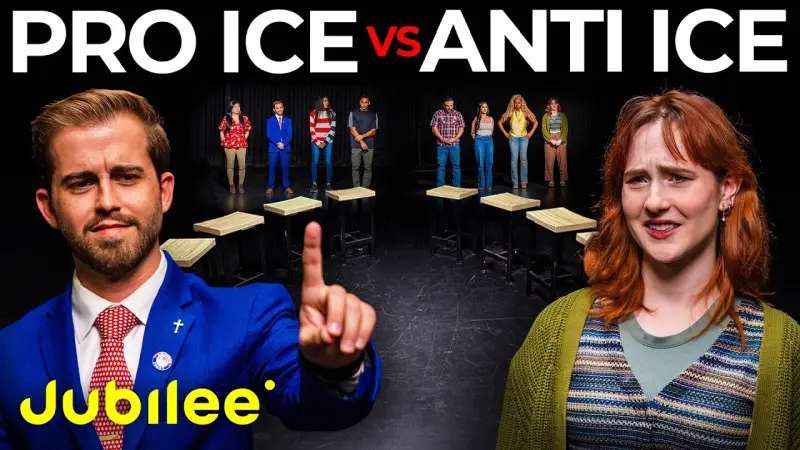
This is from Jubilee Media’s Middle Ground series, released in April 2026, bringing together eight participants (four per side) with opposing views on US immigration enforcement, including former Border Patrol agents and civil rights advocates.
Participants argue over five connected propositions: whether ICE should be abolished, whether ICE agents are unfairly vilified, whether enforcement should target only violent criminals, whether family separation is a necessary consequence of enforcement, and whether detention conditions are inhumane. The discussion ranges from legal questions (Fourth Amendment stops, birthright citizenship) to specific recent incidents (a fatal shooting in Minneapolis, whistleblower testimony on training cuts) to broader arguments about crime statistics, deportation history, and the role of private detention contractors.
Claims Defending ICE and Current Enforcement
1. Illegal entry is a crime, so due process complaints are overblown (“let me see your papers, get out”).
Fact check: Accurate as far as it goes. First-time illegal entry is a federal misdemeanor under 8 U.S.C. Section 1325; repeat entry can be a felony under Section 1326. What the claim omits: noncitizens in the US, including undocumented ones, still retain constitutional due process protections under established Supreme Court precedent. “No court case needed” understates existing legal requirements rather than describing current law.
2. Assaults on ICE officers are up dramatically (cited as “1,000%+”, 230+ incidents).
Fact check: DHS has issued a series of escalating, unverified percentage claims over 2025 (500%, 830%, 1,150%, and eventually over 1,300%), but despite repeated requests, DHS has not provided data to support those figures to independent reporters. An analysis of federal court records found roughly a 25% rise in assault charges against federal officers over a comparable period, not the four-digit percentages DHS has claimed. Real, sometimes serious, assaults on agents have occurred; the specific statistics cited are DHS’s own unconfirmed figures.
3. Most deportees have criminal records (65% with some record, 15% violent).
Fact check: This conflicts with other data raised in the same discussion. Independent analyses of 2025-2026 ICE data (Cato Institute, TRAC) have consistently found the large majority of people detained during this period have no criminal conviction, closer to the “74.3% no criminal history” figure the opposing side cites later in the same conversation. The two claims can’t both be accurate for the same population; this one appears to be the less-supported figure.
4. Obama and Clinton deported more people than Trump (“deporter-in-chief,” Clinton deported 11 million).
Fact check: Partially accurate, partially not. Obama’s two terms saw roughly 5.3 million people removed or repatriated, and Trump’s first term saw about 2 million, so the comparison direction is correct. The Clinton figure is off by an order of magnitude: Clinton-era annual deportations ranged from about 42,000 to 188,000 per year, totaling under 1 million across two terms, not 11 million.
5. “80% of countries have border control, 95% have immigration restrictions.”
Fact check: Could not be verified to a source. The general premise (virtually all sovereign states regulate immigration in some form) is broadly true, but the precise percentages appear to be an unsourced rhetorical figure rather than a traceable statistic.
6. Stephen Miller set a quota of 3,000 ICE arrests per day.
Fact check: DOJ lawyers confirmed no official written directive existed, but that a 3,000-per-day figure was verbally floated by Deputy White House Chief of Staff Stephen Miller through media interviews, and this became a point of contention in litigation over ICE’s Los Angeles operations. Accurate as described.
7. The Supreme Court ruling (“Vasquez”) shows agents are following the law, not profiling by race.
Fact check: Justice Kavanaugh’s concurrence held that apparent ethnicity alone cannot justify a stop, but can be a “relevant factor” when combined with language, location, and occupation. That’s more permissive than “not profiling” suggests to critics, and it’s worth noting this was a preliminary stay on the Court’s emergency docket, not a final ruling on the merits; three justices dissented sharply.
8. Pretti had a gun and physically engaged agents, justifying the shooting.
Fact check: Pretti was a licensed gun owner, but reporting indicates he was not pursued as a suspect and instead entered the incident while trying to assist another protester. Analysis suggests the fatal shot may have been a negligent discharge from an agent who had just removed the gun from Pretti’s holster, not Pretti firing on agents. This complicates the “he attacked with a gun” framing.
Claims Critical of ICE and Current Enforcement
1. Undocumented immigrants commit less crime than native-born citizens (about 30% less).
Fact check: Well supported in direction. One national study found undocumented immigrants are roughly 33% less likely to be incarcerated than U.S.-born individuals, while a Texas study found undocumented immigrants 47% less likely to be convicted of a crime, and a 150-year analysis found immigrants 60% less likely to be incarcerated than U.S.-born people in recent years. The 30% figure cited falls within the range multiple independent studies report; exact magnitude varies by study and crime type.
2. ICE training was cut by 240 hours (from 584), including constitutional-rights instruction, per whistleblower testimony.
Fact check: Accurate. Ryan Schwank, a former ICE academy instructor, testified to Congress that he watched ICE cut 240 hours of training from a 584-hour program. DHS disputed the characterization, stating recruits receive 56 days of training rather than the shorter figure cited, a claim Schwank directly contested under oath. This is a real, currently contested controversy, not a fabrication.
3. “Alex Prey” (Alex Pretti) was deescalating, unarmed at the moment of the shooting, and the gun that killed him misfired after being taken from him.
Fact check: Matches reporting on Alex Pretti’s death in Minneapolis, January 2026. Analysis cited in reporting concluded it is highly likely the fatal shot was a negligent discharge by an agent after removing Pretti’s Sig P320 from his holster. This remains one leading theory under active investigation, not a final official finding.
4. The Supreme Court effectively authorized profiling based on ethnicity, language, and location.
Fact check: This is the critics’ framing of a real, contested ruling. Critics describe the ruling as giving ICE agents legal cover to stop and detain people based on appearance, language, accent, or workplace, and the vote was 6-3. Technically the ruling requires factors in combination rather than ethnicity alone; whether that distinction matters in practice is the actual point of dispute.
5. ICE detention deaths spiked sharply (cited as 30 in Trump’s first year, versus 5-10/year historically).
Fact check: Accurate. At least 30 people died in ICE detention during 2025, the most in more than 20 years, compared to 11 deaths in 2024 and fewer than 10 in earlier years. Some trackers report slightly higher 2025 totals (32-33) depending on cutoff dates and counting methods, but the order of magnitude and direction are well documented.
6. Roughly 74% of people detained or deported recently have no criminal history.
Fact check: Consistent with independent tracking of 2025-2026 ICE detention data cited by multiple outlets. This directly conflicts with the “65% have criminal records” figure raised by the opposing side earlier in the same discussion; that internal contradiction is worth noting rather than resolving definitively, since it likely reflects two different populations or time windows being compared loosely.
7. US oil sanctions on Venezuela caused a 75% GDP collapse, driving migration.
Fact check: The specific 75% figure could not be verified. Venezuela’s economic collapse and US sanctions on its oil sector are both well documented, but economists generally attribute the crisis to multiple compounding factors (sanctions, hyperinflation, government mismanagement, falling oil production), not sanctions alone. This claim is directionally plausible but overstated as a single-cause explanation.
8. The 14th Amendment’s birthright citizenship clause was created only for children of freed slaves, not immigrants.
Fact check: Inaccurate as a legal claim. The 14th Amendment (1868) was primarily motivated by securing citizenship for formerly enslaved people, but its text states a general rule, not one limited to that group. The Supreme Court confirmed in United States v. Wong Kim Ark (1898) that it applies broadly to children born on US soil to noncitizen parents, with narrow exceptions such as children of foreign diplomats. This is settled, longstanding constitutional law, though currently facing a fresh legal challenge.
9. Detention conditions include denied medication, unsanitary conditions, and understaffing linked to for-profit contractors.
Fact check: Broadly consistent with independent reporting. ICE detention facility inspections dropped by over 36% in 2025 even as the detained population grew, and ICE halted payments to medical contractors in October 2025, not expected to resume until spring 2026. Specific granular details (maggots in food, denial of sanitary products) are hard to verify claim-by-claim without a named facility and date, but they are consistent with a well-documented systemic pattern rather than being outlier fabrications.
