
What the Electoral College Is
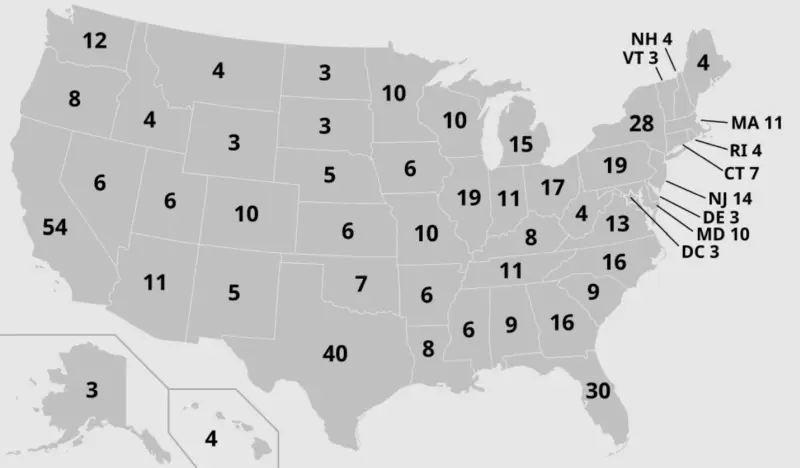
The Electoral College is the system the United States uses to choose its president. Americans do not vote for president directly. Instead, each state holds its own popular vote, and the winner of that state’s vote usually receives all of that state’s electors, people who then cast the actual votes that decide the presidency. There are 538 electors in total, and a candidate needs at least 270 to win.
Each state gets a number of electors equal to its number of members in the House of Representatives plus its two senators. Larger states have more electors; smaller states have a guaranteed minimum of three. Washington, D.C. also has three electors, added by constitutional amendment in 1961, even though it has no voting members of Congress. Because of this, the number of electors is only loosely tied to a state’s actual population; smaller states end up with slightly more influence per voter than larger ones.
In 48 states, the system is winner-take-all: whichever candidate gets the most votes in that state, even by a narrow plurality, receives all of that state’s electors. Maine and Nebraska are exceptions; they split some of their electors by congressional district. This means a candidate can lose the national popular vote but still win the presidency, if they win the right combination of states. This has happened at least four times in U.S. history, most recently in 2000 and 2016. Some historians count a fifth instance in 1824, though that election involved unusual circumstances that make direct comparison difficult.
Where the System Came From
The Electoral College was created at the Constitutional Convention in 1787. The delegates were debating how to choose a president and could not agree. Some wanted Congress to choose the president directly. Others wanted a direct national popular vote. The Electoral College was a compromise between these positions, and it also reflected the political reality of the time, including the fact that enslaved people, who could not vote, still counted toward a state’s population and therefore its number of electors under the three-fifths compromise. This gave slaveholding states more influence in presidential elections than their voting population alone would have provided.
The system was not fully settled at the start. Early elections exposed problems, including a tie in 1800 between two candidates from the same party, which led to the Twelfth Amendment in 1804. That amendment separated the voting for president and vice president and set up most of the process still used today. If no candidate reaches 270 electoral votes, the Constitution provides for a contingent election, meaning the House of Representatives chooses the president. This has happened only twice, in 1800 and 1824, and it has not been close to happening in modern times, though the possibility remains part of the system.
Points of Debate and Controversy
The Electoral College is one of the most argued-about features of American government. These are genuine disagreements, not settled questions.
Does it protect smaller states and regional balance? Supporters argue the system reflects American federalism, the idea that the country is a union of states, not just a mass of individual voters. They argue it forces candidates to build broad, geographically diverse coalitions rather than focusing only on the most populous cities. Critics respond that in practice, candidates do not campaign broadly at all; they concentrate almost entirely on a small handful of closely divided swing states, while most states, large and small, are ignored because their outcome is not in doubt.
Can the popular vote loser become president? Yes, and this is the most cited criticism of the system. Because of winner-take-all rules, a candidate can assemble exactly enough state wins to reach 270 electoral votes while losing the nationwide vote count by a wide margin. Defenders of the current system argue that the Electoral College was never meant to mirror the national popular vote, and that changing the rules after the fact simply because of a disliked outcome is not a strong argument on its own. Critics argue that a system that can regularly produce a president most voters did not choose is difficult to defend as democratic.
What about faithless electors? Electors are technically free to vote for someone other than the candidate their state’s voters chose. This has happened occasionally in U.S. history, though never in a way that changed an election’s outcome. Most states now have laws requiring electors to vote as pledged, and the Supreme Court upheld the constitutionality of such laws in 2020. Supporters of the current system see this as a settled non-issue; some critics argue it highlights an odd feature of a system that still technically relies on individual human discretion rather than a direct vote count.
Should the Electoral College be replaced? Public opinion polling has shown majority support for switching to a national popular vote in recent years, though a formal constitutional amendment to abolish the Electoral College is extremely difficult, since it would require approval from two-thirds of Congress and three-quarters of the states, an unlikely threshold given how the system currently benefits smaller and swing states politically. As a workaround, a group of states have adopted the National Popular Vote Interstate Compact, an agreement to award all of their electors to whoever wins the national popular vote, once enough states join to guarantee that outcome. As of mid-2026, 18 states and the District of Columbia, controlling 222 electoral votes, have joined the compact, still 48 votes short of the 270 needed to take effect. Supporters say this achieves reform without a constitutional amendment. Critics raise legal questions about whether such a compact is constitutional without congressional approval, and note that every state to join so far has been Democratic-leaning, which raises its own questions about whether the compact could ever attract enough bipartisan support to reach 270.
Why This Matters
The rules for choosing a president shape how candidates campaign, which voters get courted, and which states matter most in a given election. Because the Electoral College can produce outcomes that diverge from the national popular vote, and because reforming it is so difficult, it remains one of the most consequential and unresolved structural debates in American politics. You do not need to take a side in this debate to understand why so many Americans have strong opinions about it.
Glossary
Electoral College (noun) — the system of electors, rather than a direct national vote, used to choose the U.S. president.
Translations: 选举人团 | 選挙人団 | 선거인단 | निर्वाचक मंडल | المجمع الانتخابي | коллегия выборщиков | colegio electoral | collège électoral
- The Electoral College has 538 members, and a candidate needs 270 to win.
- Understanding the Electoral College is necessary to understand U.S. presidential elections.
elector (noun) — a person chosen to formally cast a vote for president on behalf of their state.
Translations: 选举人 | 選挙人 | 선거인 | निर्वाचक | ناخب | выборщик | elector | électeur
- Each state selects a group of electors based on the outcome of its popular vote.
- An elector almost always votes for the candidate their state’s voters chose.
amendment (noun) — a formal change or addition to the Constitution.
Translations: 修正案 | 修正条項 | 수정안 | संशोधन | تعديل | поправка | enmienda | amendement
- Washington, D.C. received electors through a constitutional amendment in 1961.
- Abolishing the Electoral College would require a constitutional amendment.
winner-take-all (adjective) — a system in which the candidate with the most votes receives all of the available prize, with no partial credit for others.
Translations: 赢者全拿 | 勝者独占方式 | 승자독식 | विनर-टेक-ऑल | نظام الفوز للجميع | принцип “победитель получает все” | de todo o nada | système du tout au vainqueur
- Most states use a winner-take-all rule to award their electors.
- Critics argue the winner-take-all system can distort the national outcome.
plurality (noun) — the largest single share of votes, even if it is less than half of the total.
Translations: 相对多数 | 相対多数 | 최다득표 | बहुलता | الأغلبية النسبية | относительное большинство | pluralidad | pluralité
- A candidate can win a state with only a plurality, not a true majority.
- Winning a narrow plurality is enough to claim all of a winner-take-all state’s electors.
Convention (noun) — here, the 1787 Constitutional Convention, the meeting where the U.S. Constitution was written.
Translations: 制宪会议 | 憲法制定会議 | 제헌회의 | संविधान सम्मेलन | المؤتمر الدستوري | конституционный конвент | convención constitucional | convention constitutionnelle
- The Electoral College was designed at the Constitutional Convention in 1787.
- Delegates at the Convention disagreed sharply over how to choose a president.
contingent election (noun) — the process by which the House of Representatives chooses the president if no candidate wins a majority of electoral votes.
Translations: 权变选举 | 非常時選出 | 비상 선거 | आकस्मिक चुनाव | الانتخاب الاحتياطي | условные выборы | elección contingente | élection contingente
- A contingent election has happened only twice in U.S. history.
- If no candidate reaches 270 votes, a contingent election would decide the presidency.
federalism (noun) — a system of government in which power is divided between a central government and individual states or regions.
Translations: 联邦制 | 連邦制 | 연방주의 | संघवाद | النظام الفيدرالي | федерализм | federalismo | fédéralisme
- Supporters argue the Electoral College reflects American federalism.
- Debates about federalism often come up when discussing how much power states versus the national government should have.
swing state (noun) — a state where the outcome of an election is closely contested and could go to either major party.
Translations: 摇摆州 | 接戦州 | 경합주 | स्विंग स्टेट | ولاية متأرجحة | колеблющийся штат | estado péndulo | état pivot
- Presidential candidates focus most of their campaigning on a handful of swing states.
- A swing state can determine the outcome of an entire national election.
faithless elector (noun) — an elector who votes for a candidate other than the one their state’s voters chose.
Translations: 失信选举人 | 裏切り選挙人 | 배신 선거인 | विश्वासघाती निर्वाचक | ناخب غير أمين | неверный выборщик | elector infiel | électeur infidèle
- A faithless elector has never changed the outcome of a presidential election.
- Most states now have laws to prevent a faithless elector from voting against their pledge.
popular vote (noun) — the total number of individual votes cast by citizens, counted nationwide.
Translations: 普选票 | 一般得票 | 국민 투표 | लोकप्रिय वोट | التصويت الشعبي | всенародное голосование | voto popular | vote populaire
- A candidate can lose the national popular vote and still win the presidency.
- Support for switching to a popular vote system has grown in recent polling.
compact (noun) — a formal agreement between states.
Translations: 协定 | 協定 | 협정 | अनुबंध | اتفاقية | соглашение | pacto | pacte
- The National Popular Vote Interstate Compact is an agreement among a group of states.
- Critics question whether the compact is constitutional without congressional approval.
National Popular Vote Interstate Compact (noun) — an agreement among states to award all their electors to the winner of the national popular vote, once enough states join to guarantee that result.
Translations: 全国普选跨州协定 | 全国的普通選挙州間協定 | 전국 국민투표 주간 협약 | राष्ट्रीय लोकप्रिय वोट अंतरराज्यीय समझौता | اتفاقية التصويت الشعبي الوطني بين الولايات | межштатный договор о национальном всенародном голосовании | pacto interestatal del voto popular nacional | pacte interétatique pour le vote populaire national
- The National Popular Vote Interstate Compact currently has 222 of the 270 electoral votes it needs.
- Every state that has joined the National Popular Vote Interstate Compact so far leans Democratic.
threshold (noun) — the minimum level or amount required before something takes effect.
Translations: 门槛 | 基準値 | 기준선 | सीमा | حد أدنى | пороговое значение | umbral | seuil
- The compact will only take effect once it reaches the 270-vote threshold.
- Amending the Constitution requires meeting a very high approval threshold.
coalition (noun) — a group formed by combining different people or groups with a shared goal.
Translations: 联盟 | 連合 | 연합 | गठबंधन | تحالف | коалиция | coalición | coalition
- Supporters argue the system forces candidates to build a broad national coalition.
- Critics argue candidates build a narrow coalition aimed only at swing states.
distort (verb) — to change something so it no longer accurately reflects the original.
Translations: 扭曲 | 歪曲する | 왜곡하다 | विकृत करना | يشوه | искажать | distorsionar | déformer
- Critics argue winner-take-all rules can distort the national outcome.
- A narrow focus on a few states can distort which voters candidates pay attention to.
Discussion Questions
- Does your country choose its leader through a direct national vote, or a different system?
- Do you think a president should be chosen by total votes nationwide, or by winning individual states or regions?
- Why do you think smaller states are given more electoral influence per voter than larger states?
- Is it acceptable for a candidate to become president without winning the most votes nationwide?
- How do you think swing-state campaigning affects voters in states that are not closely contested?
- Should electors be legally required to vote the way their state’s voters chose, or should they be free to use their own judgment?
- Why do you think changing the Electoral College through a constitutional amendment is so difficult?
- What do you think of the National Popular Vote Interstate Compact as a way to change the system without an amendment?
- Does it matter to you that every state in the compact so far leans one political direction?
- What are the risks of a system where the outcome depends on a small number of closely divided states?
- Do you think most Americans understand how the Electoral College works? Why or why not?
- Imagine you are redesigning how your country chooses its leader. What system would you create, and why?
Related Links
- National Archives: About the Electoral College
- Constitution Annotated: Article II, Section 1 (Selection of Electors)
- Encyclopaedia Britannica: Electoral College
- Oyez: Chiafalo v. Washington (2020, faithless electors case)
- National Popular Vote: official site (advocacy for the compact)
- FairVote: The Electoral College (reform-oriented perspective)
- Heritage Foundation: Why We Need the Electoral College (opposing perspective)
