
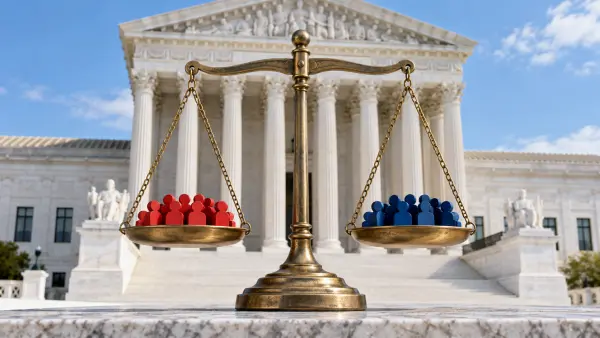
Supreme Court Justice Elena Kagan said Tuesday that her conservative colleagues’ rulings on voting rights, campaign finance and partisan gerrymandering have weakened American democracy and deepened political polarization. She spoke at Catholic University’s law school in Washington, two weeks before the midterm elections. Her remarks put a familiar dispute in unusually direct terms: when courts step back from policing elections, are they respecting the limits of their role or leaving politicians free to tilt the rules?
What happened?
The Washington Post reported that Kagan sharply criticized this year’s rulings limiting the Voting Rights Act and loosening campaign finance restrictions. She also faulted the 2019 decision that removed federal courts from oversight of partisan gerrymandering. Kagan dissented from each of those rulings.
The Associated Press, in a report carried by ABC News, quoted her saying the court has created “a democracy that does not work as well as it should.” Her remarks were a justice’s assessment of the court’s record, not a new ruling or a change in election law.
The three rulings behind her criticism
Rucho v. Common Cause (2019). In a 5-4 decision, the court held that claims of excessive partisan gerrymandering are political questions beyond federal courts’ reach. The consolidated cases involved a Republican map in North Carolina and a Democratic map in Maryland. Chief Justice John Roberts wrote that judges lacked a clear, manageable standard for deciding how much partisanship is too much, and pointed to Congress, state legislatures, state constitutions and independent commissions as avenues for reform. Kagan wrote the dissent.
Louisiana v. Callais (April 29, 2026). In a 6-3 decision written by Justice Samuel Alito, the court struck down a Louisiana congressional map with a second majority-Black district as an unconstitutional racial gerrymander. According to a summary of the ruling, the court did not declare Section 2 of the Voting Rights Act unconstitutional, but it added requirements that make vote-dilution claims harder to win. Kagan wrote the dissent, arguing the decision leaves Section 2 close to unenforceable.
NRSC v. FEC (June 30, 2026). In another 6-3 ruling along ideological lines, the court struck down federal limits on coordinated spending between political parties and candidates as violations of the First Amendment.
What different sides are saying
Kagan’s criticism: Courts cannot protect democratic competition simply by declining to intervene. Politicians who benefit from distorted maps or unlimited spending have little incentive to change them, she argued, and the cumulative effect is a political system that serves voters less well. Bloomberg reported she called unlimited election spending a “nightmare.”
The majority’s legal reasoning: An objectionable political practice does not automatically give federal judges authority to resolve it. In Rucho, the majority distinguished its ruling on judicial power from approval of gerrymandering. In Callais, it held that complying with the Voting Rights Act did not justify Louisiana’s use of race in drawing districts. In the campaign finance case, it concluded that the limits restricted political speech.
A limit on her argument: Kagan also said it is unfair to claim the court’s majority reflexively backs the president, according to the AP. That complicates any simple reading of her remarks as a partisan attack.
What the disagreement means
There are two separate questions here: whether an election rule harms democratic competition, and whether the Constitution or federal law authorizes courts to remedy that harm. Kagan and the conservative majority differ sharply over how those questions connect. Her remarks do not settle that dispute. They do offer a framework for judging future decisions: which institution can address the problem, what legal standard applies, and whether the available remedy gives voters a practical way to demand change.
