
This briefing reflects information available as of September 5, 2026. MI-10 is a live, competitive race, and candidates, polling, and endorsements may change before the November 3 election.
Why This Race Matters
Michigan’s 10th Congressional District has no incumbent on the ballot this year. Republican Rep. John James is running for governor instead of seeking reelection, leaving an open seat that both parties consider one of the most important in the country for control of the U.S. House.
The seat has a short but volatile history. It was created for the 2022 election, and James won it that first time by fewer than 1,600 votes. Democratic nominee Christina Hines and Republican nominee Michael Bouchard are now competing to define what the district looks like without James on the ballot.
The Race
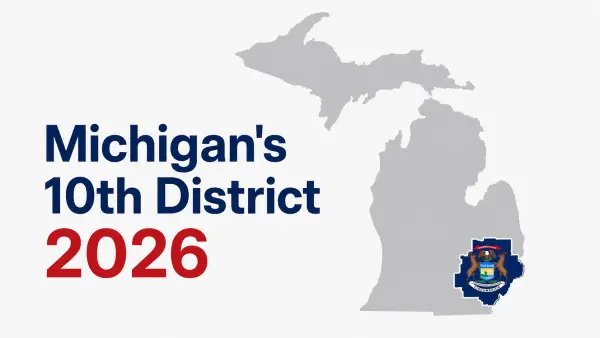
MI-10 covers southern Macomb County, including Warren, Sterling Heights, and Clinton Township, along with Rochester and Rochester Hills in Oakland County. It includes Selfridge Air National Guard Base and sits near major automotive and defense manufacturing, including the Detroit Arsenal in Warren. Macomb County has long been described as Reagan Democrat territory, a working-class, historically Democratic-leaning area that has swung toward Republicans in recent presidential cycles, and its auto-worker population gives organized labor a significant voice in the district’s politics.
The district has trended Republican since its creation: Trump carried it by 1 point in 2020 and by 7 points in 2024, according to Cook Political Report, which still rates the seat highly competitive. James won reelection in 2024 by about 6 points, a considerably stronger showing than his 2022 near-miss.
Cook Political Report moved the race from Lean Republican to Toss Up on August 25, alongside Florida’s 14th District, in one of the more notable ratings shifts of the cycle. Both the DCCC and NRCC have named MI-10 a top target, and it is one of a small number of open seats without an incumbent running in either direction.
Bouchard won a four-candidate Republican primary on August 4 with about 72 percent of the vote after President Trump endorsed him, the Detroit News reported, defeating Justin Kirk and Army veteran Steffan Demetropoulos. Hines won a three-way Democratic primary the same day over Eric Chung and former Pontiac Mayor Tim Greimel. As of July 15, according to Ballotpedia, Bouchard had raised $1.47 million to Hines’s $1.21 million.
The Candidates
Michael Bouchard (R) is an Army captain in the Michigan Army National Guard who returned from a nine-month deployment to Iraq in October 2025 and began campaigning the next day. He is the son of longtime Oakland County Sheriff Michael Bouchard, now serving his seventh term, and a graduate of Michigan State University’s ROTC program who has served with the 82nd and 101st Airborne Divisions, earning a Bronze Star for leadership on a joint task force against ISIS.
Bouchard has centered his campaign on manufacturing and defense jobs tied to Selfridge Air National Guard Base and the Detroit Arsenal, along with border security and law enforcement. The Midwesterner reported he raised more than $425,000 in his first full fundraising quarter after entering the race, an early sign of the financial support that helped him clear a crowded primary field. He has generally defended the Trump administration’s trade approach, describing the president as a skilled negotiator defending American manufacturing against unfair practices by China and, at times, Canada.
Christina Hines (D) is a former special victims prosecutor who grew up in Warren and attended its public schools. She spent a decade prosecuting cases including homicide, human trafficking, and child abuse, first as an assistant prosecutor in Wayne County and later heading the Special Victims Unit in Washtenaw County. She ran unsuccessfully for Macomb County Prosecutor in 2024, losing to incumbent Peter Lucido 57 percent to 43 percent.
Hines has centered her campaign on affordability, protecting Social Security and Medicare from cuts, and gun-safety measures including universal background checks and red flag laws. Announcing her run, she said she would fight “combatting high costs at the grocery store” and standing against cuts to Social Security and Medicare, according to Michigan Advance. She has been endorsed by EMILYs List, former Macomb County Prosecutor Carl Marlinga, and Sterling Heights Mayor Michael Taylor.
Top Issues
Tariffs and the auto supply chain. This is the defining issue of the general election. New U.S. tariffs on Canadian vehicles, parts, and metals took effect in late August, and Canada’s retaliatory tariffs on more than 700 U.S. products are scheduled to take effect September 8. Semafor reported Hines arguing Canada is not to blame for the trade dispute and casting Bouchard as a candidate who “falls in line” with the president, while Bouchard has framed the tariffs as tough negotiating that ultimately protects Michigan manufacturing.
Affordability. Hines has centered her general-election message on grocery, health care, and child care costs, framing the race as a chance to check what she describes as billionaire influence over economic policy. Bouchard has focused more on jobs and manufacturing than on direct cost-of-living messaging.
Public safety and law enforcement. Bouchard’s platform emphasizes his own military service and his family’s law-enforcement background; Hines emphasizes her decade as a prosecutor handling violent crime cases, including gun violence, as her own public-safety credential.
Social Security and Medicare. Hines has warned of cuts to both programs under the current Congress. We did not find a specific Bouchard statement opposing Social Security or Medicare, and his campaign has not made changes to either program a stated priority.
Evidence Check
Bouchard’s framing of tariffs as protecting American manufacturing is a genuine policy position, but the underlying economic picture is more contested than either campaign’s shorthand suggests. Reporting on the U.S.-Canada auto trade relationship notes that automotive parts often cross the border multiple times before a vehicle is finished, meaning new tariffs raise costs on both sides of a deeply integrated supply chain rather than cleanly benefiting one country’s manufacturers over the other’s.
Hines’s claim that Bouchard “falls in line” with Trump is a characterization rather than a specific voting-record claim, since Bouchard has never held federal office and has no voting record to assess. It is fair to note he sought and received Trump’s endorsement and has echoed the administration’s language on trade, but that framing describes rhetorical alignment, not a documented pattern of votes.
The claim that Canada’s retaliatory tariffs could affect roughly $1.5 billion in Michigan exports comes from a Detroit News analysis of federal trade data, which we consider a credible, checkable source, though the final economic impact will depend on how long the tariffs remain in place and whether a negotiated settlement follows.
Both candidates’ biographies emphasize military service, and both are accurately described: Bouchard’s Army service, deployment to Iraq, and Bronze Star are documented in multiple outlets, and Hines’s decade as a prosecutor handling violent crime is confirmed by her professional record. Neither biography appears embellished in available reporting.
Supporter Voices
Bouchard has picked up endorsements from a genuine mix of local and national figures, including Macomb County Commissioner Don VanSyckel and Clinton Township Trustee Dan Kress, alongside national figures like Ohio Rep. Jim Jordan and Colorado Rep. Gabe Evans. The local officials give his campaign a district-level presence beyond the national endorsements.
Hines’s local backing includes Sterling Heights Mayor Michael Taylor and former Macomb County Prosecutor Carl Marlinga, both figures with direct standing in the district’s largest city and its legal community. We were not able to locate an on-record quote from an ordinary MI-10 voter for either candidate, a gap worth noting rather than filling with an endorsement press release.
How This Race Is Being Framed
Republicans are framing this as a defense of Trump-era economic policy in a manufacturing district, betting that tariff pain will be temporary and that voters will credit the administration for trying to bring jobs home. Bouchard’s military service and local family name are central to that pitch in a county where his father remains a well-known elected official.
Democrats are framing the race around the immediate cost of tariffs to a district built on cross-border auto manufacturing, arguing that abstract trade strategy matters less to voters than rising prices this fall. Hines’s message has focused on making Bouchard answer for the timing of Canada’s retaliatory tariffs, which land just two months before the election.
Cook Political Report’s decision to move this race to Toss Up right alongside Florida’s 14th District suggests forecasters see a real pattern of Republican-held, newly competitive seats tightening at the same time, rather than MI-10 being an isolated case.
Related Links
- Cook Political Report: MI-10 race summary
- Ballotpedia: Hines and Bouchard head to November
- Semafor: tariffs become a campaign flashpoint
- Detroit News: Bouchard wins the GOP primary
- Detroit News analysis: retaliatory tariffs and Michigan
- Michigan Advance: Hines launches her campaign
- The Midwesterner: Bouchard’s early fundraising
Discussion Questions
- Have tariffs or trade policy affected your own household costs or your work in the past year?
- Does it matter to you that neither candidate has previously held federal office?
- How should voters weigh a candidate’s family name and local ties against their own individual record?
- Do you find Bouchard’s or Hines’s framing of the tariff fight more persuasive?
- Why might an open seat, with no incumbent, behave differently than a race with a sitting member of Congress?
- What would it take for you to trust a claim like “falls in line,” used to describe a candidate with no voting record?
- How much should a single trade dispute, arriving right before an election, shape your vote?
- Should military service carry particular weight when evaluating a candidate for Congress?
- Why do you think forecasters moved this race and Florida’s 14th District to Toss Up at the same time?
- Imagine you work in Michigan’s auto supply chain. What would you want your next representative to prioritize first?
