
This briefing reflects information available as of September 5, 2026. OH-07 is a live, competitive race, and candidates, polling, and endorsements may change before the November 3 election.
Why This Race Matters
Ohio’s 7th Congressional District looked like safe Republican territory for most of this cycle. Then, this summer, disputed but serious allegations against Republican Rep. Max Miller upended the race, and three independent forecasters now call a seat Donald Trump carried by double digits a genuine toss-up against Democrat Brian Poindexter.
Republicans nationally are watching to see whether Miller’s decision to stay on the ballot costs the party a seat it would otherwise hold easily. Democrats need to flip only a handful of seats to take the House, and a district this Republican becoming competitive changes the map of where that fight is happening.
The Race
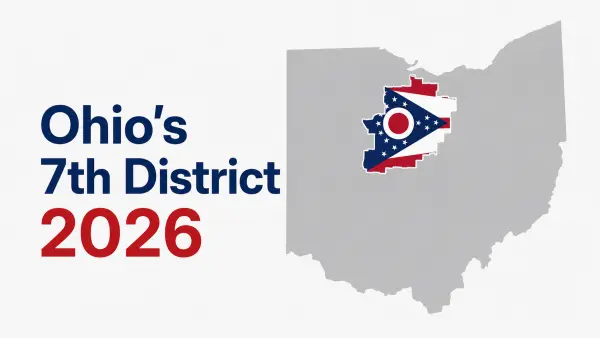
OH-07 was redrawn for 2026 under Ohio’s new bipartisan-mapping requirements and now covers southern and western Cuyahoga County, Medina and Wayne counties, and portions of Holmes and Ashland counties. Signal Ohio reports Trump carried the district by 11 points in 2024, and Inside Elections calculates a baseline of roughly R+10, well to the right of a separate R+5 figure that appears in some older district summaries and may not reflect the final 2026 map. The area includes Rocky River, Miller’s own hometown, along with a mix of Cleveland-area suburbs and rural Amish country in Holmes County.
Miller ran unopposed in the May 5 Republican primary and has put $1 million of his own money into the race. Poindexter, a union ironworker and Brook Park council member, won an eight-candidate Democratic primary with 37 percent of the vote, well ahead of former Cuyahoga County Executive Ed FitzGerald’s 22 percent, and was endorsed by Sen. Bernie Sanders, who called him “a fighter for workers’ rights.”
Cook Political Report, Sabato’s Crystal Ball, and Inside Elections have all moved the race to toss-up, each citing the same cause: allegations against Miller rather than any shift in the district’s underlying partisan lean. Inside Elections noted that an August survey from the Republican-aligned firm co/efficient found Poindexter leading 47 percent to 33 percent, with Miller’s support among Republicans falling below 70 percent, while a Democratic firm’s poll put the margin at 54 to 46 percent.
The Candidates
Max Miller (R) is a Marine Corps Reserve veteran and former Trump campaign and White House aide who won this seat in 2022 after Rep. Anthony Gonzalez retired rather than seek reelection following his vote to impeach Trump. In Congress, Miller voted to impeach former Homeland Security Secretary Alejandro Mayorkas and co-sponsored a resolution condemning political violence after the 2024 attempt on Trump’s life.
Miller’s re-election campaign has been overshadowed by allegations from his ex-wife, Emily Moreno, the daughter of Ohio’s junior U.S. senator, Bernie Moreno. She has accused Miller of domestic violence toward her and their young daughter during their marriage and divorce; Newsweek reported Miller denies the allegations, calling them false, and no criminal charges have been filed. The dispute is playing out alongside a custody battle over their daughter.
Brian Poindexter (D) is a member of Ironworkers Local 17 and an at-large Brook Park city councilman who has worked in his union’s apprenticeship program. Brook Park is a legacy Ford factory town, and Poindexter’s campaign has leaned heavily on that blue-collar identity. His campaign has centered almost entirely on affordability and working-class representation, and observers have noted he has largely avoided cultural and identity-politics issues that often divide swing districts.
Poindexter has drawn support from building-trades unions and received $5,000 contributions from several labor organizations, according to his campaign finance reports. He continued working in the ironworkers’ apprenticeship program through the end of the spring semester before taking a leave to campaign full time. His primary victory over a field that included a former county executive and several better-funded rivals was read locally as a sign of union mobilization behind his candidacy.
Top Issues
The allegations against Miller. This has become the dominant issue in the race, eclipsing traditional policy debates. Ohio’s other U.S. senator, Jon Husted, and Sen. Bernie Moreno both publicly called on Miller to withdraw; Miller has refused, and the deadline for Ohio Republicans to replace him on the ballot has passed.
Affordability. Poindexter has built his campaign around grocery, housing, and health care costs, a message his campaign says resonates across the district’s political spectrum. Miller’s campaign has emphasized his fundraising strength and continued backing from House Republican leadership rather than engaging heavily on cost-of-living messaging.
Candidate self-funding. Miller’s $1 million personal investment in his own campaign is a notable data point during a period when Republican fundraising vehicles have shown some hesitance about the seat, an indirect sign of how the party’s national apparatus is weighing the risk.
Party discipline. The refusal of national Republican leadership to force Miller off the ballot, despite two sitting Ohio senators calling for his withdrawal, has itself become a campaign issue, with Democrats arguing it shows the party prioritizes seat count over accountability.
Evidence Check
The allegations against Miller remain disputed and unproven in court. His ex-wife has made specific accusations of domestic violence and child abuse; Miller has denied them and says he will clear his name. No criminal charges have been filed as of this writing, and any House Ethics Committee review would take time to reach conclusions. We are treating the underlying allegations as contested rather than established, while treating the political fallout, including Senate Republicans’ public calls for his withdrawal, as a separately verifiable fact.
The claim that Miller “can win this seat” because of who his in-laws are, made in his own CNN interview, is a prediction rather than a fact, and the polling described above runs in the opposite direction of his confidence. We are not in a position to say which will prove correct with two months remaining before the election.
The R+5 Cook PVI figure that appears in some district reference material predates the finalized 2026 map and does not match the roughly R+10 to R+11 baseline that Inside Elections and Signal Ohio calculate from the district’s actual 2026 boundaries. We are flagging this as an artifact of redistricting timing rather than a genuine disagreement about the district’s lean.
Supporter Voices
Miller has maintained public support from House Republican leadership. In a CNN interview, he argued his constituents’ familiarity with his family situation, not distance from it, would carry him to reelection, saying they “know who my ex-father-in-law is” and would back him anyway.
Ironworkers Local 17 business manager Jordan, discussing Poindexter’s candidacy, told the Cleveland Building Trades that union members “hope to get someone in there for the working class.” That is a genuine, district-connected labor voice, though we were not able to locate an on-record quote from an ordinary OH-07 voter outside organized labor or elected officials for either candidate.
How This Race Is Being Framed
Republicans are visibly split. Two of Ohio’s most prominent GOP officials, Sen. Husted and Sen. Moreno, have called for Miller to leave the race, while the Republican National Committee has offered only tepid support, saying the party will back its nominees while acknowledging that “nobody’s a winner” in a divorce. House Speaker Mike Johnson has continued to stand behind Miller.
Democrats are framing the race as a test of whether national Republicans will pay a price for standing by a candidate facing serious allegations, while being careful not to build their entire campaign around the controversy given that the underlying claims remain legally unresolved. Poindexter’s own messaging has stayed focused on affordability rather than the allegations themselves.
The unanimous toss-up rating from all three major forecasters, explicitly tied to Miller’s situation rather than any change in the district’s partisanship, is unusual. It suggests that if Miller’s standing recovers or the allegations fade from the news, the seat could snap back toward its underlying Republican lean.
Related Links
- Signal Ohio: can Democrats flip this seat
- Inside Elections: Miller makes it a toss-up
- Newsweek: allegations draw renewed attention
- PBS: Moreno calls on Miller to resign
- The Hill: race moves to toss-up
- Who is Brian Poindexter
- Cleveland Building Trades: Poindexter wins the primary
Discussion Questions
- How should voters weigh serious but unproven allegations against a candidate who denies them?
- Does it matter to you that Miller’s own party’s senators, not just Democrats, called for him to withdraw?
- Do you think a party should be able to remove a nominee from the ballot after allegations like these surface?
- Why might a candidate like Poindexter choose to avoid national cultural debates in his campaign?
- What would it take for you to trust a poll released by a firm aligned with one of the campaigns?
- How much should a scandal affecting one candidate change how you evaluate the underlying issues in a race?
- Should self-funding a campaign be viewed differently than raising the same amount from donors?
- Do you think this seat’s competitiveness will hold if Miller’s situation is resolved before November?
- What responsibility do national party committees have when a nominee faces serious allegations?
- Imagine you are a lifelong Republican voter in this district. What would decide your vote this year?
