
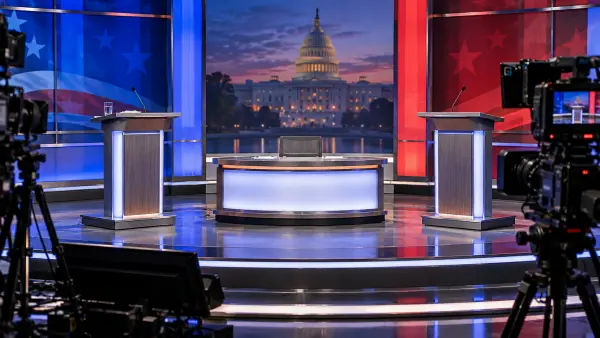
Seven closely watched midterm races, five for governor and two for the Senate, have no debate on the calendar with 23 days left before the November 3 election. In some, one candidate has refused outright. In others, nobody has said yes. This dispatch covers who is declining, what each side says, and what the missing debate could mean for the race. It takes no position on who should debate or who is right.
The pattern reaches beyond these seven. Axios counted no agreed debates in five of ten closely watched governor races. Candidates and analysts offer different explanations. The Boston Globe lists shrinking local TV audiences, turnout-focused campaigns, heavy ad spending, thinner local news coverage, and the risk that a debate hurts a candidate more than it helps.
Texas Senate: A Challenge Accepted, a Stage Still Empty
Republican Attorney General Ken Paxton has not agreed to debate Democrat James Talarico. According to the Texas Tribune, Talarico has accepted at least four invitations, including one from CNN, and proposed a Fox News debate moderated by Bret Baier, which Fox later agreed to host. A Paxton spokesperson said in July, “of course we’re going to debate,” but the campaign has not committed to any event and has not answered recent requests for comment. Paxton declined to debate in each of his three attorney general campaigns.
On October 7, President Trump urged Talarico on Truth Social to join a debate, calling Paxton “ready, willing and able,” Fox 4 reported. Talarico replied on X, “Ball’s in your court.” The exchange sits alongside a separate dispute. Talarico has not campaigned since September 30. His campaign says he has the flu and will return the weekend of October 10, while Paxton questioned his whereabouts at a rally and posted a “wanted” poster.
Paxton’s side has given no public reason for the delay. SMU political scientist Matthew Wilson told the Tribune that Paxton would face questions about his past legal and ethical controversies. Rice University’s John Alford said underdogs usually want debates because they have less to lose. Both are expert opinion, not statements from the campaign.
Fact-check: The July statement and the lack of any commitment are not contradictory, but they leave the question open. This article could not verify the flu explanation. The most recent full poll located is a UT/Texas Politics Project survey conducted August 5 to 13 of 1,200 registered voters, showing Talarico at 42%, Paxton at 39%, Libertarian Ted Brown at 3% and 14% with no preference (margin of error about 2.8 points). Fox 4 reports a YouGov poll on October 8 with Talarico ahead by six, but this article could not locate its full numbers.
Possible impact: Wilson said debates rarely move voters unless a candidate makes a serious mistake. If that holds, the main effect of no debate may be narrative: Talarico can say Paxton is avoiding him, and Paxton can point to Talarico’s absence. Whether voters weigh either point is not something the available evidence shows.
Texas Governor: Abbott Has Debated Before, but Not Yet This Year
Gov. Greg Abbott (R) has not publicly agreed to debate Democratic state Rep. Gina Hinojosa. The Tribune reports he debated his Democratic opponents in 2014, 2018 and 2022 and won each race by double digits. Hinojosa has accepted four invitations from local television networks, and told NBC News that if Abbott won’t debate her, he “shouldn’t be governor of Texas.” Abbott’s campaign has given no reason.
Down the ballot, Democrats seeking lieutenant governor and attorney general have urged their Republican opponents to debate, and neither Republican campaign responded to the Tribune’s requests for comment. A railroad commissioner debate on October 22 has been agreed to by the Democrat but not confirmed by the Republican.
Fact-check: The UT/Texas Politics Project poll above put Abbott at 45% and Hinojosa at 40%, with about 10% undecided. The Tribune says some recent polls show Abbott trailing, which would be new for him, but this article could not verify that claim.
Possible impact: Wilson told the Tribune that a closer race forces Abbott to weigh the risks of debating more carefully. That is an expert reading of his incentives, not Abbott’s stated view. A candidate who leads has less to gain from a shared stage, and Hinojosa’s argument that skipping it is disqualifying depends on voters caring about it.
Ohio Governor: Acton Declines, Ramaswamy Accepts
Democrat Amy Acton has refused to debate Republican Vivek Ramaswamy. Signal Ohio reported that her campaign gave its answer on September 2, the day Ramaswamy announced he had accepted invitations from WLWT in Cincinnati and CNN and challenged her to join him.
Her campaign manager, Phil Stein, called Ramaswamy “a scam artist who spreads baseless lies about her and her family,” according to News 5 Cleveland. The campaign says Ramaswamy has falsely portrayed Acton as having a substance abuse problem. Ohio Republican Party chair Alex Triantafilou called the refusal a failure of duty and said she is not prepared to lead. State Senate Minority Leader Nickie Antonio, a Democrat, praised Acton for not taking the bait and said debates have become brawls rather than policy discussions. The Libertarian candidates, Don Kissick and James Mills, have agreed to debate each major candidate separately, and Mills said voters deserve to hear from everyone on the ballot.
University of Cincinnati professor David Niven noted that debates happen in about half of Ohio’s major races. In his view, Acton’s decision is passive, and Ramaswamy’s eagerness suggests his campaign is struggling. Both points are his analysis, not established fact.
Fact-check: The substance abuse claim is the campaign’s characterization of Ramaswamy’s messaging, and this article could not independently verify it. Three recent polls, as summarized by American Bazaar, show Acton ahead: NYT/Siena (September 22 to October 1, 616 likely voters) at 49% to 45%, Suffolk/USA Today Network Ohio at 50% to 41%, and Marist (registered voters) at 50% to 44%. The same report says other polls have shown the race tied or Ramaswamy leading, with no figures given. This article did not review the pollsters’ own releases.
Possible impact: Acton leads in all three polls cited, so skipping the stage costs her little if the polls hold. Her choice also gives Ramaswamy the argument that she is avoiding scrutiny. We found no polling that tests whether a refusal changes votes.
Arizona Governor: Hobbs Tours Instead, Biggs Debates Anyway
Gov. Katie Hobbs (D) has declined to debate Republican Rep. Andy Biggs. Her campaign says a debate stage is built for “short soundbites and political theater,” the Arizona Mirror reported. She is instead on an “Arizona First Tour” and has held more than 100 open-press events and interviews. Hobbs also refused to debate Kari Lake in 2022, and went on to win that race.
The Biggs campaign argues that independents in particular deserve a traditional debate. Biggs said he would attend the October 6 Clean Elections Commission debate regardless. AZPM listed it with the Green and No Labels candidates, and with Hobbs absent. This article could not find coverage of what was said at the event, so it does not report on it.
Fact-check: The most recent public poll located is a HighGround survey from August 15 to 18 of likely voters, with Hobbs at 49.5% and Biggs at 34.3% (margin of error 4.9 points). It is nearly two months old.
Possible impact: Hobbs followed the same approach in 2022, and her campaign says direct voter contact works better. A double-digit lead in the one poll found suggests she has little pressure to change course. For Biggs, an empty podium gives a visual contrast. Whether it persuades anyone is untested.
Florida Governor: Jolly Withdraws, Donalds Sets Terms
Democrat David Jolly has declined to debate Republican Rep. Byron Donalds, after first accepting proposals from the Tampa Bay Tiger Bay Club and CBS Miami, WGCU reported. Jolly said debates would not produce an honest conversation and accused Donalds of bad faith, saying, “You can’t debate a liar.” Donalds accepted three debates in a press release, with conditions that included no audience. He says Jolly’s position has shifted and that Jolly lacks substance, and has called Jolly scared.
If no debate is held, it would be Florida’s first governor’s race without a general election debate since 1974, according to Axios and WGCU.
Fact-check: Jolly’s claim that Donalds lies is a charge from one side, and this article did not test it. The Donalds campaign’s description of Jolly’s shifting position cites Jolly’s own earlier statements about debates, which this article could not verify. A Mason-Dixon poll for NBC6 and Telemundo, conducted September 28 to October 1 among 625 registered voters, had Donalds at 48% and Jolly at 41%, with 10% undecided (margin of error up to 4 points). A Fox 13 headline described polls as effectively tied, but this article could not retrieve those figures.
Possible impact: Here the candidate who trails in the poll cited is the one declining, which runs against the usual view that challengers want the stage. Jolly’s stated reason is about Donalds’ conduct, not strategy. Donalds’ offer gives him the line that Jolly turned down three debates, though his own no-audience condition is a term Jolly’s side could contest.
North Carolina Senate: Two Candidates Who Say They Are Open
Democrat Roy Cooper and Republican Michael Whatley have not agreed to a debate, and neither has given a reason. The Assembly reported on August 31 that Cooper said his team was “happy to sit down and discuss the potential for a debate.” Whatley said he is willing to debate but has not publicly pushed for one. WUNC reported on September 10 that Spectrum, the N.C. Association of Broadcasters, and WUNC with the UNC School of Journalism had all invited them, and none of the invitations had been accepted.
Cooper has debated before, twice during his run for governor and once in his 2020 reelection campaign. The last time North Carolina’s major-party Senate nominees did not debate was 1998, when Republican Lauch Faircloth declined to share a stage with John Edwards. Political scientist Eric Heberlig says Whatley, the less-known candidate, would gain visibility from a debate. GOP consultant Charles Hellwig argues that Cooper would be better off avoiding one. The Assembly also notes that Cooper’s staff typically allows one question per event. Those are the views of outside commentators, not the campaigns.
Fact-check: The RealClearPolling listing has Cooper ahead of Whatley in all ten recent polls, from 5 points in several surveys to 15 in one, with an East Carolina University poll (September 30 to October 3) at 50% to 43%. RealClearPolling’s own average for September 6 to October 3 is Cooper 49.8% and Whatley 41.0%. This article could not confirm whether any debate talks have taken place since September 10.
Possible impact: This is the only race of the seven where both sides say they are open, so a late agreement remains possible. Without one, the lack of a debate leaves voters with campaign ads and rallies in a race where Cooper has led every listed poll.
Nevada Governor: Ford Asks for Three Debates, Lombardo Has Not Answered
Democratic Attorney General Aaron Ford challenged Gov. Joe Lombardo (R) on June 17 to three debates, according to News From The States. Ford accused Lombardo of “avoiding press, dodging questions, and refusing accountability.” His conditions were debates in Las Vegas and Reno, a cost-of-living town hall, at least one Spanish-language broadcast, and a date after Labor Day. Lombardo’s campaign had not responded when that story ran, and Axios reports he has still not publicly committed. He debated Democratic Gov. Steve Sisolak once in 2022.
Ford has his own record to answer for. He declined to debate his Democratic primary opponent, Washoe County Commissioner Alexis Hill, saying in March that speaking directly to voters was the best way to reach them. When asked in June what had changed, a Ford spokesperson did not say.
Fact-check: We could not find a public statement from Lombardo’s campaign explaining the silence. The two candidates are close in the most recent poll located, an Emerson College survey for KLAS-TV from September 5 to 8 of 680 likely voters, with Ford at 44%, Lombardo at 42% and 11% undecided (margin of error 3.7 points).
Possible impact: In a near-tied race, both sides have something at stake. Ford’s primary refusal gives Lombardo a ready answer to his criticism. Lombardo’s silence lets Ford keep making the accountability argument. Nothing in the reporting shows either point moving voters.
What the Seven Races Share
The refusals do not follow one party or one poll position. Democrats are the ones declining in Ohio, Arizona and Florida. Republicans have not committed in either Texas race, and the North Carolina and Nevada situations are unresolved. The leader in the polls cited declines in Ohio and Arizona. In Florida, the trailing candidate declines.
The stated reasons also differ: personal attacks in Ohio, a preference for open press events in Arizona, alleged bad faith in Florida, and no reason at all in Texas, North Carolina and Nevada. Experts quoted here disagree about the stakes. Some say debates help trailing candidates, and others say they rarely change outcomes. This article found no study in the sources reviewed that measures what happens to a candidate who skips one.
Note on Scope
This dispatch reflects reporting available as of October 11, 2026, and any of these races could schedule a debate at short notice. It covers five governor races and two Senate races chosen because a refusal or a stalemate has been reported. It does not cover House races, Virginia (where Sen. Mark Warner cited his Senate schedule), Arkansas (where Sen. Tom Cotton is skipping a planned debate), the Ohio and Minnesota Senate races, or Florida’s Senate race, where WGCU reports Sen. Ashley Moody declined to debate Democrat Angie Nixon. An earlier announcement of Florida Atlantic University debates in October could not be reconciled with that report. Several pages, including some poll write-ups, could not be retrieved, and the poll figures above come from the cited secondary reports.
Related Links
- Axios: Debate-shy, candidates aren’t sharing the stage like they used to
- Texas Tribune: Texas Republicans are refusing to debate for the election
- News 5 Cleveland: Acton refuses to engage with Ramaswamy as Ohio debates decline
- WGCU: Florida’s general election has no statewide debates
- WUNC: North Carolina Senate race debates and local interviews
- Fox 4: Trump calls for debate between Talarico and Paxton
Discussion Questions
- Have you ever watched a political debate? Did it change how you saw a candidate?
- Should candidates be expected to debate, or is it a personal strategic choice?
- Does a candidate’s refusal to debate make you more or less likely to vote for them?
- Do you find Acton’s reason or Ramaswamy’s challenge more persuasive in Ohio?
- Is a candidate who tours the state and takes press questions doing the same job as one who debates?
- Should the leader in the polls have to debate a trailing opponent?
- Why do you think so many races are skipping debates this year?
- How would you weigh a refusal based on an opponent’s behavior against one based on strategy?
- Would you want debate rules set by an independent commission instead of by the campaigns?
- Imagine you are a campaign manager with a six-point lead. Would you agree to a debate, and why?
