
Overview
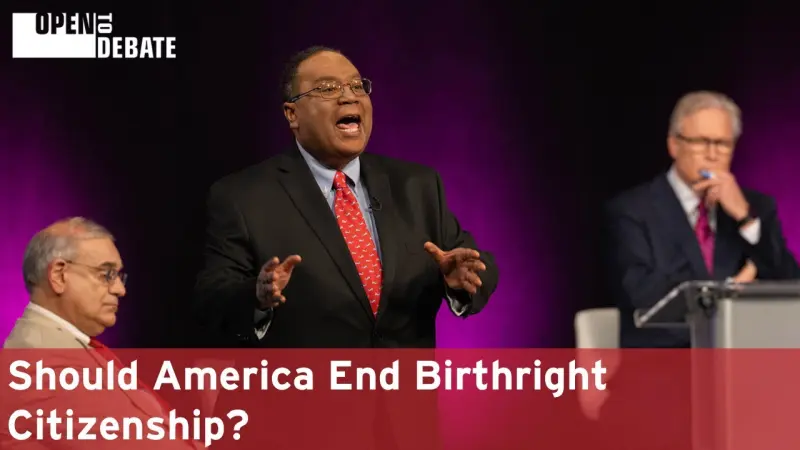
This is an episode of Open to Debate, recorded live at Arizona State University’s Walter Cronkite School of Journalism and released November 4, 2025. Host John Donvan moderated a formal two-against-two debate on the question: should America end birthright citizenship? Arguing yes were Horace Cooper, senior fellow with the National Center for Public Policy Research and chairman of the Project 21 National Advisory Board, and Mark Krikorian, executive director of the Center for Immigration Studies. Arguing no were Kris Mayes, Attorney General of Arizona, and Chris Newman, legal director of the National Day Laborer Organizing Network. The debate followed a structured format (opening statements, open discussion, closing statements) and included audience questions from ASU students. The debate took place before the Supreme Court ruled on the underlying legal question in June 2026; that ruling is noted at the end of this post.
Claims Made by the Side Arguing to End Birthright Citizenship
1. The 14th Amendment was written specifically to protect formerly enslaved people, not to guarantee citizenship to children of any nationality born on US soil.
Fact check: This reflects a genuine, longstanding interpretive dispute rather than a settled fact. The amendment’s history does center on securing citizenship for freed slaves after the Civil War, but its text uses general language (“all persons born…in the United States”), and the Supreme Court held in United States v. Wong Kim Ark (1898) that this general language extends beyond that original context to children of noncitizens generally, with narrow exceptions. Both readings have real legal grounding; this is contested, not resolved.
2. Justice Harlan’s dissent (referenced in both Plessy v. Ferguson and Wong Kim Ark) supports the narrower reading of the 14th Amendment.
Fact check: Partially accurate, with one correction. Harlan did write the sole dissent in Plessy v. Ferguson (1896). In Wong Kim Ark (1898), however, the dissent was authored by Chief Justice Melville Fuller, with Harlan joining it rather than writing it himself. The substance of the claim, that a dissenting opinion existed arguing for a narrower reading, is accurate; the specific authorship attributed to Harlan in this instance is not.
3. Unrestricted birthright citizenship has roots in English feudal law, not something the amendment’s framers necessarily intended to preserve in its modern form.
This is a historical framing point rather than a checkable factual claim. It is accurate that jus soli (citizenship by birthplace) has roots in English common law; whether that origin undermines its legitimacy in the US constitutional context is a matter of interpretation, not fact.
4. The scale of modern immigration, millions of visa holders, students, and an estimated 15 million undocumented immigrants, is fundamentally different from conditions in 1868, justifying a policy change.
Fact check: The undocumented immigrant population estimate cited (around 15 million) is within the range of some recent estimates, though other credible estimates place the figure lower, around 11 to 13 million; there is no single authoritative real-time count. The broader claim that immigration volume today differs enormously from 1868 is not disputed. Whether that difference alone justifies reinterpreting a constitutional guarantee is a values-based argument, not a factual one.
5. Roughly a quarter of a million births per year are to undocumented immigrants, plus around 70,000 to non-immigrant visa holders, plus an unknown number of “birth tourism” births.
These figures come from Krikorian’s own organization, the Center for Immigration Studies, and were not independently verified in this fact check. The Southern Poverty Law Center designates CIS a hate group, tied to founder John Tanton’s documented history of eugenics advocacy and racially motivated writing; Krikorian and CIS dispute this characterization as unfounded and politically motivated. Both the designation and the dispute are real and worth knowing about when weighing the source, but neither one, by itself, confirms or refutes the specific birth statistics cited.
6. Every developed country except the United States and Canada has ended unconditional birthright citizenship.
Fact check: This is roughly accurate but overstated as an absolute. Several wealthy nations (the UK, Australia, France, India) did have unconditional jus soli at some point and later added residency or parental-status conditions. It is accurate that unconditional, unrestricted birthright citizenship is now unusual among wealthy nations outside North America, and more common across Latin America and the Caribbean, a detail the claim omits.
7. The phrase “subject to the jurisdiction thereof” was inserted specifically to exclude Native Americans on tribal reservations, showing the amendment’s authors intended some categories of people to be excluded from automatic citizenship.
Fact check: Accurate as a matter of history. Native Americans on reservations were generally not considered subject to full US jurisdiction at the time and were not granted birthright citizenship until the Indian Citizenship Act of 1924. This is a genuine textual and historical basis for arguing the phrase carries a narrower meaning than “anyone born on US soil,” though critics note this exception was tied to tribal sovereignty specifically, a different legal basis than immigration status.
8. Legal and illegal immigration should be treated differently: children of legal immigrants should keep citizenship, while children of undocumented immigrants or temporary visa holders should not.
This is a policy proposal, not a factual claim. Newman’s rebuttal, that Wong Kim Ark’s own parents were barred from naturalizing under the Chinese Exclusion Act, and so the “legal versus illegal” line was already blurred in the foundational case, is an accurate historical point: race-based naturalization bars did exist until 1952, and Wong Kim Ark’s parents could not have naturalized regardless of any other circumstance.
9. If birthright citizenship were ended by Congress rather than executive order, practical administrative models exist, such as Australia’s ten-year residency rule or France’s system tied to a child’s status at 18.
Fact check: Accurate. Australia and France do use conditional birthright citizenship models along these lines. Whether such a system could be implemented in the US without significant administrative disruption, as Mayes and Newman argue, was not resolved in the debate and remains a genuinely disputed practical question.
10. Black Americans are increasingly wary of high immigration levels due to perceived competition for jobs, housing, and school resources.
This claim was presented without a specific cited source in the debate. Polling on this question exists and shows mixed results depending on the survey, timing, and question wording; I did not verify a specific data point behind this particular claim, so it should be treated as an assertion rather than a confirmed fact.
Claims Made by the Side Arguing to Keep Birthright Citizenship
1. The 14th Amendment’s text is plain: anyone born in the US and subject to its jurisdiction is a citizen, without exception for parents’ status.
Fact check: Accurate as a description of the amendment’s text and of the Supreme Court’s holding in Wong Kim Ark, which has stood as governing precedent for over 125 years. Whether the text should be read as narrowly or broadly as the Court has read it remains the live legal dispute, as covered above.
2. Wong Kim Ark (1898) affirmed birthright citizenship applies regardless of parents’ citizenship status, decided by justices who were contemporaries of the amendment’s drafting.
Fact check: Accurate. The ruling did affirm this broad application, and several justices at the time had lived through the amendment’s ratification 30 years earlier, which Mayes offers as evidence they understood its intended scope. This is a reasonable inference, not direct proof of original intent.
3. Undocumented immigrants are, in fact, “subject to the jurisdiction” of the United States, since they can be arrested and prosecuted under US law.
This is a legal argument rather than a standalone factual claim, and it is the central point of dispute in the debate. It is accurate that undocumented immigrants are subject to US criminal and civil law. Whether that satisfies the specific constitutional phrase “subject to the jurisdiction thereof,” which has a distinct legal history tied to full political allegiance rather than mere physical presence, is exactly what is contested.
4. No president can change a constitutional right through executive order, and doing so would be unconstitutional.
This reflects the general legal consensus, later borne out by every lower court that reviewed Trump’s executive order, all of which ruled against it prior to this debate. Whether the underlying constitutional question would ultimately be resolved the same way by the Supreme Court was still open at the time of this debate; see the update below.
5. Ending birthright citizenship risks creating a stateless or permanent noncitizen underclass born in the US.
This is a predicted consequence, not a fact that can be verified in advance. It is a commonly raised concern among legal scholars and is taken seriously enough that Krikorian himself, on the opposing side, agreed it should be avoided and cited other countries’ administrative solutions as evidence it is avoidable.
6. Every judge who has reviewed Trump’s executive order on birthright citizenship, as of this debate, has ruled against it.
Fact check: Accurate as of the debate’s recording. Multiple federal courts blocked the order in 2025. This does not resolve the ultimate outcome, since further appeals, including to the Supreme Court, were pending; see the update below for what has happened since.
7. Wong Kim Ark’s own parents could not have naturalized under US law at the time due to race-based restrictions, undermining the “legal versus illegal” framing used to justify restricting birthright citizenship today.
Fact check: Accurate. The Chinese Exclusion Act and race-based naturalization bars, not lifted until 1952, meant Wong Kim Ark’s parents had no legal path to citizenship regardless of behavior. This is a valid historical point, though it addresses the foundational case’s context rather than settling today’s separate legal question about the 14th Amendment’s current meaning.
8. John Bingham, a principal author of the 14th Amendment’s first section, described its purpose in 1867 as ensuring that any person born in the US, regardless of race, could claim citizenship.
Fact check: Accurate as a matter of the historical record; Bingham’s 1867 remarks, quoted in the debate, are documented in the Congressional Globe. This supports a broad original intent, though Cooper and Krikorian would likely note that Bingham’s remarks were made in the specific context of formerly enslaved people, so what he intended for that group is not automatically dispositive of how the text should apply to all future circumstances.
9. Practical objections raised by the other side, such as identifying parentage or preventing birth tourism, could be addressed through statutory or visa reform without touching the Constitution or birthright citizenship itself.
This is a policy proposal, not a factual claim. It is a reasonable alternative approach in principle; whether it would be politically or administratively easier than the approach favored by Cooper and Krikorian was not tested in the debate.
10. Birthright citizenship predates the 14th Amendment, tracing back to English common law and early American colonial practice.
Fact check: Accurate. Jus soli was inherited from English common law and applied in the American colonies and early states prior to 1868. Mayes’s point that without it, many present-day US citizens descended from earlier immigrants would not be citizens is a reasonable historical observation, not a formal legal argument about the current dispute.
Update Since This Debate
On June 30, 2026, the Supreme Court ruled 6-3 in Trump v. Barbara that Trump’s executive order seeking to end birthright citizenship is invalid, with a narrower 5-4 majority holding it violates the 14th Amendment directly, and Justice Kavanaugh separately concluding it violates existing federal statute rather than the Constitution itself. This directly resolves the specific executive order discussed in this debate, though Kavanaugh’s separate reasoning leaves open the possibility that Congress, rather than the president, could revisit the question through legislation, a point raised by several participants in this debate itself. We covered this ruling in detail in an earlier post.
Related Links
- Open to Debate: Should America End Birthright Citizenship? (full episode and transcript)
- Oyez: United States v. Wong Kim Ark (1898)
- Wikipedia: Center for Immigration Studies
- Southern Poverty Law Center: Anti-Immigrant Network (background on CIS/FAIR designation)
- PolitiFact: Is the Center for Immigration Studies a hate group, as the SPLC says?
- Constitution Annotated: 14th Amendment, Citizenship Clause
Discussion Questions
- Which side’s opening argument did you find more persuasive, and why?
- Does it matter to you that Justice Harlan joined, rather than wrote, the Wong Kim Ark dissent?
- Do you think the scale of modern immigration is a good reason to reinterpret a constitutional guarantee?
- How much weight should a think tank’s disputed reputation carry when judging the statistics it publishes?
- Should courts or Congress be the ones to change a rule like birthright citizenship?
- Do you find the comparison to Australia’s or France’s conditional citizenship systems convincing for the US?
- What do you think about Newman’s argument that Wong Kim Ark’s parents could not have immigrated legally anyway?
- Does knowing the Supreme Court later ruled on this question change how you view the debate?
- Do you think debates like this one change people’s minds, or mostly reinforce existing views?
- Imagine you were an audience member at this debate. What question would you have asked?
