
What Happened
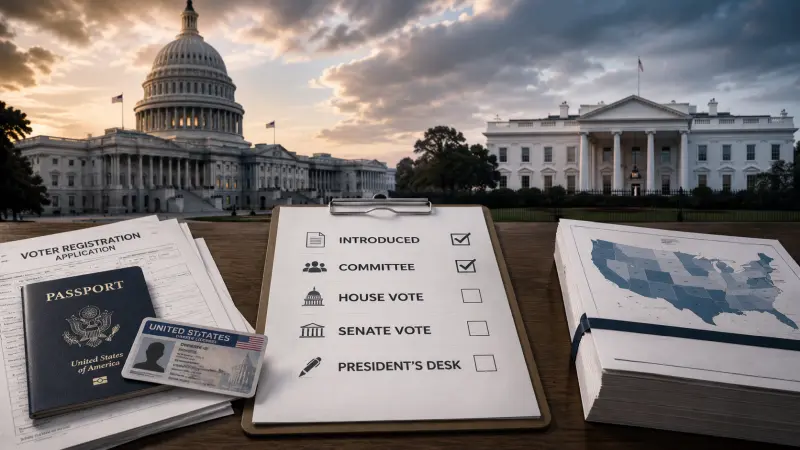
The SAVE America Act has become one of President Donald Trump’s top legislative priorities. Although the Republican-controlled House of Representatives passed the bill earlier this year, it has stalled in the Senate, where it lacks enough votes to overcome the filibuster.
Rather than moving on to other legislation, Trump has repeatedly urged Congress to pass the bill first. He has delayed signing unrelated legislation, including a bipartisan housing bill, in an effort to increase pressure on lawmakers. The dispute has created tensions not only between Republicans and Democrats but also within the Republican Party itself, as some lawmakers have sought to attach the SAVE America Act to other legislation while others have questioned that strategy.
Background
The SAVE America Act is an election reform bill intended to strengthen federal voting requirements. According to the legislation and public reporting, its main provisions include:
- Requiring proof of U.S. citizenship when registering to vote in federal elections.
- Requiring voters to present photo identification when casting ballots in federal elections.
- Creating a national voter database using voter registration records provided by the states.
- Expanding federal oversight of voter registration records and maintenance.
Important: Some reports have described additional proposals connected to the legislation. However, not all reported provisions appear in publicly available versions of the bill. Readers should distinguish between the confirmed legislative text and proposals discussed during negotiations.
What Different Viewpoints Are Saying
Supporters: Supporters argue that requiring proof of citizenship and photo identification would strengthen election integrity and increase public confidence in election results. They note that only U.S. citizens may legally vote in federal elections and say the bill would make voter registration systems more accurate.
Fact check: Federal law already limits voting in federal elections to U.S. citizens. Research has generally found that voting by non-citizens is rare, although supporters argue that stronger safeguards help prevent future violations and improve public trust.
Opponents: Critics argue that the bill could make voting more difficult for eligible citizens who do not have easy access to documents such as passports, birth certificates, or other proof of citizenship. They also question whether the proposal addresses a widespread problem.
Fact check: Multiple voting rights organizations and election experts have raised concerns that documentation requirements could disproportionately affect some eligible voters, including married people whose legal names have changed, lower-income Americans, and people born outside hospitals whose records may be harder to obtain. Whether these effects would occur depends on how the law would be implemented if enacted.
The political dispute: Trump has argued that passing the SAVE America Act should take priority over other legislation and has encouraged congressional Republicans to make it a central focus of the legislative agenda.
Fact check: Trump has publicly stated that he would withhold his signature from other bills until Congress passes the SAVE America Act. However, many senators from both parties remain opposed to the legislation, making Senate approval uncertain under current rules.
What the Bill Would and Would Not Do
If enacted, the SAVE America Act would establish new federal requirements for voter registration and identification in federal elections. It would not automatically change every aspect of state election law, although states would need to comply with applicable federal requirements for federal contests.
The bill has not become law. It has passed the House but remains stalled in the Senate. As a result, none of its proposed requirements currently apply nationwide.
Related Links
- Reuters: Housing bill will be sent to Trump on Monday
- Reuters: Trump’s voting restrictions bill may fail, but parts live on in 23 states
- Reuters: House dispute over SAVE America Act
- Congress.gov: Legislative information
- National Conference of State Legislatures: Election policy resources
Discussion Questions
- Do you think proof of citizenship should be required to register to vote?
- How easy or difficult would it be for most people to obtain the required documents?
- Should election security or voting access receive greater emphasis?
- Do you think this bill would increase public confidence in elections?
- Should federal election rules be more uniform across all states?
- What concerns raised by supporters seem most important to you?
- What concerns raised by opponents seem most important to you?
- Should a president delay other legislation to pressure Congress on a priority bill?
- Why do election laws often become politically controversial?
- Imagine you are a senator. Would you vote for this bill? Why or why not?
