
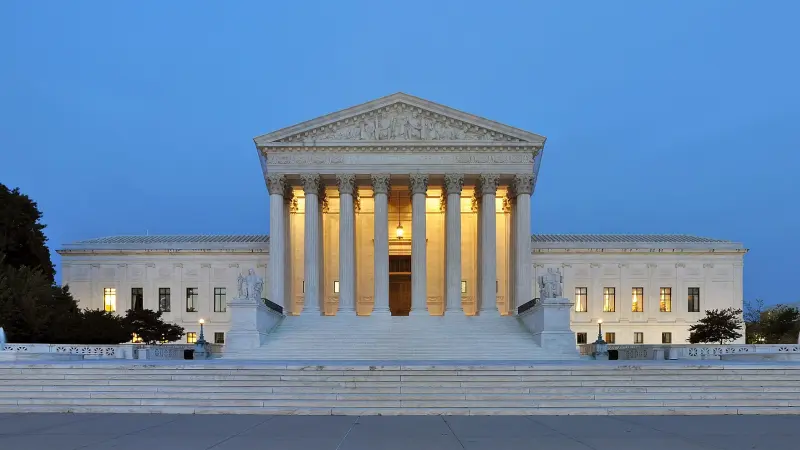
What the Supreme Court Is
The Supreme Court is the highest court in the United States. It sits at the top of the judicial branch, one of the three branches of the federal government, alongside the legislative branch (Congress, which makes laws) and the executive branch (the president, who carries out laws). The Court has the final word on questions of federal law and the meaning of the U.S. Constitution. When the Supreme Court decides a case, no other court can overrule it, and its decisions apply to the entire country.
The Court is made up of nine justices. One is the Chief Justice, who leads the Court, and the other eight are Associate Justices. Justices are nominated by the president and must be confirmed by the Senate before they can take their seats. Once confirmed, a justice can serve for life, or until they choose to retire. This lifetime tenure is meant to protect justices from political pressure, so they can make decisions based on law rather than on the wishes of whoever is in power at the moment.
A Short History
The Supreme Court was created by Article III of the Constitution in 1789, but the Constitution said very little about how the Court should work. It did not even fix the number of justices, which changed several times before settling at nine in 1869. In its early years, the Court was seen as the weakest of the three branches. It had no army, no budget power, and no clear way to enforce its own rulings.
That changed with a famous 1803 case, Marbury v. Madison. In that case, the Court claimed the power of judicial review, the authority to strike down laws passed by Congress if the Court decides they violate the Constitution. This power is not written directly in the Constitution. The Court gave it to itself through interpretation, and it has been accepted ever since. Judicial review is the main reason the Supreme Court became as powerful as it is today. It means the nine justices can cancel the decisions of elected lawmakers, a striking amount of power for people who are not elected.
Over the following two centuries, the Court shaped American life through its rulings. It has ended and, at times, upheld racial segregation, defined the limits of free speech, decided questions about privacy and personal rights, and settled disputes between the president and Congress. Some of its decisions are now widely admired. Others are remembered as serious mistakes. The Court’s history is not a straight line of progress; it reflects the arguments and values of each era.
How the Court Works
Thousands of parties ask the Supreme Court to hear their cases each year, but the Court accepts only a small number, usually fewer than one hundred. Four of the nine justices must agree to take a case before it is heard. The Court tends to choose cases that raise important legal questions or where lower courts have reached conflicting answers.
When the Court hears a case, lawyers for each side present oral arguments, and the justices question them directly. Afterward, the justices discuss the case privately and vote. One justice writes the majority opinion, which explains the Court’s decision and becomes binding law. Justices who disagree may write a dissent, explaining why they think the majority is wrong. Dissents have no legal force, but they can influence future courts and shape public debate. A ruling can be decided by a wide margin or by a narrow 5 to 4 vote, and the size of the margin often signals how settled or contested the legal question is.
An important idea guiding the Court is precedent, the principle that the Court should generally follow its own past decisions. Precedent gives the law stability and predictability. However, the Court can and sometimes does overturn its own precedents when a majority believes an earlier decision was clearly wrong. When to respect precedent and when to overturn it is one of the most contested questions in American law.
Points of Debate and Controversy
The Supreme Court’s power places it at the center of ongoing arguments. These are genuine disagreements among Americans, and thoughtful people take different sides.
How should the Constitution be interpreted? Some justices and scholars favor originalism, the view that the Constitution should mean what its words were understood to mean when they were written. Others favor the idea of a “living Constitution,” the view that its meaning can develop as society changes. Supporters of originalism argue it limits the personal opinions of judges and keeps power with elected lawmakers. Supporters of the living-Constitution approach argue that an eighteenth-century document cannot answer every modern question without some interpretation. Neither side has “won” this debate; it runs through nearly every major case.
Is the Court too political? Because justices are chosen by presidents and confirmed by the Senate, the selection process has become intensely partisan. Critics argue that the Court now often divides along the lines of the party of the president who appointed each justice, which makes it look less like a neutral court and more like another political body. Others respond that justices frequently surprise the presidents who appointed them, and that disagreement among justices reflects honest differences in legal thinking rather than pure politics. The evidence can be read both ways, and how much the Court’s splits reflect politics versus legal philosophy is itself disputed.
Should justices serve for life? Lifetime tenure was designed to protect judicial independence. But critics point out that it can lead to justices serving for thirty years or more, and it means the timing of a death or retirement can give one president outsized influence over the Court for a generation. Some reformers propose fixed terms, such as eighteen years, so that appointments would be more regular and predictable. Supporters of the current system argue that lifetime tenure remains the best protection against political pressure, and that term limits might make justices think about their next job while still deciding cases. Any such change might require a constitutional amendment, which is very difficult to pass.
Should the size of the Court be changed? The number of justices is set by law, not by the Constitution, so Congress could change it. At various points, people frustrated with the Court’s direction have proposed adding seats, a step critics call court-packing. Supporters of expansion argue it could correct what they see as an unbalanced Court. Opponents warn that if one party adds seats, the other will do the same when it gains power, which could damage the Court’s authority permanently. This debate tends to grow louder whenever the Court is closely divided or issues rulings that anger a large part of the public.
Why This Matters
The Supreme Court touches questions that affect daily life: what rights people have, how much power the government holds, and where the limits of that power lie. Because its rulings are hard to change and apply to everyone, understanding how the Court works, and why people argue about it, is part of understanding American government itself. You do not have to agree with any particular side of these debates to see why they matter.
Glossary
judicial (adjective) — relating to courts, judges, or the legal system.
Translations: 司法的 | 司法の | 사법의 | न्यायिक | قضائي | судебный | judicial | judiciaire
- The Supreme Court sits at the top of the judicial branch of government.
- A judicial decision can affect millions of people who were never part of the case.
legislative (adjective) — relating to the making of laws.
Translations: 立法的 | 立法の | 입법의 | विधायी | تشريعي | законодательный | legislativo | législatif
- Congress holds the legislative power to write and pass federal laws.
- The legislative branch and the courts sometimes disagree about what a law means.
executive (adjective) — relating to the branch of government that carries out and enforces laws.
Translations: 行政的 | 行政の | 행정의 | कार्यकारी | تنفيذي | исполнительный | ejecutivo | exécutif
- The president leads the executive branch of the federal government.
- Courts can review whether an executive action follows the Constitution.
Constitution (noun) — the fundamental document that establishes a country’s system of government and basic laws.
Translations: 宪法 | 憲法 | 헌법 | संविधान | دستور | конституция | constitución | constitution
- The Supreme Court has the final say on what the Constitution means.
- Changing the Constitution requires a long and difficult amendment process.
justices (noun) — judges who serve on the Supreme Court or other high courts.
Translations: 大法官 | 裁判官 | 대법관 | न्यायाधीश | قضاة | судьи | jueces | juges
- Nine justices currently serve on the U.S. Supreme Court.
- The justices discuss each case privately before they vote.
nominated (verb) — formally proposed for a position or office.
Translations: 提名 | 指名された | 지명된 | नामांकित | مُرشَّح | выдвинутый | nominado | nommé
- A justice is nominated by the president before the Senate votes.
- Being nominated does not guarantee that a person will be confirmed.
tenure (noun) — the period during which someone holds a position, or the right to hold it securely.
Translations: 任期 | 在任期間 | 재임 기간 | कार्यकाल | مدة الخدمة | срок полномочий | mandato | mandat
- Lifetime tenure is meant to protect justices from political pressure.
- Some reformers want to replace lifetime tenure with fixed terms.
judicial review (noun) — the power of courts to decide whether a law or government action violates the Constitution.
Translations: 司法审查 | 違憲審査 | 사법 심사 | न्यायिक समीक्षा | المراجعة القضائية | судебный надзор | revisión judicial | contrôle judiciaire
- Judicial review allows the Court to strike down laws it finds unconstitutional.
- The power of judicial review was established in 1803, not written in the Constitution.
oral arguments (noun) — the spoken presentations lawyers make to a court, during which judges may ask questions.
Translations: 口头辩论 | 口頭弁論 | 구두 변론 | मौखिक दलीलें | المرافعات الشفوية | устные прения | argumentos orales | plaidoiries orales
- During oral arguments, the justices questioned both lawyers directly.
- Oral arguments give each side a chance to answer the Court’s concerns.
majority (noun) — the larger group; here, the group of justices whose opinion becomes the Court’s decision.
Translations: 多数 | 多数派 | 다수 | बहुमत | الأغلبية | большинство | mayoría | majorité
- One justice writes the majority opinion, which becomes binding law.
- A narrow majority of five to four often signals a contested question.
dissent (noun) — a written opinion by a judge who disagrees with the majority decision.
Translations: 异议 | 反対意見 | 반대 의견 | असहमति | رأي مخالف | особое мнение | disidencia | opinion dissidente
- A dissent has no legal force but can influence future courts.
- Her dissent argued that the majority had misread the Constitution.
precedent (noun) — an earlier decision that guides how similar cases should be decided later.
Translations: 先例 | 判例 | 선례 | पूर्व-निर्णय | سابقة قضائية | прецедент | precedente | précédent
- The Court generally follows precedent to keep the law stable.
- Overturning a long-standing precedent is controversial and rare.
originalism (noun) — the view that the Constitution should be interpreted according to its meaning at the time it was written.
Translations: 原旨主义 | 原意主義 | 원의주의 | मूलवाद | الأصلانية | оригинализм | originalismo | originalisme
- Supporters of originalism say it limits the personal opinions of judges.
- Critics of originalism argue that old text cannot answer every modern question.
partisan (adjective) — strongly supporting one political party, often in a biased way.
Translations: 党派的 | 党派的な | 당파적인 | पक्षपातपूर्ण | حزبي | партийный | partidista | partisan
- The confirmation process has become intensely partisan in recent decades.
- Critics worry the Court’s rulings look increasingly partisan.
independence (noun) — freedom from control or influence by others.
Translations: 独立 | 独立性 | 독립성 | स्वतंत्रता | استقلال | независимость | independencia | indépendance
- Lifetime tenure is meant to protect judicial independence.
- Some argue that political pressure threatens the Court’s independence.
amendment (noun) — a formal change or addition to a legal document such as the Constitution.
Translations: 修正案 | 修正条項 | 수정안 | संशोधन | تعديل | поправка | enmienda | amendement
- Setting fixed terms for justices might require a constitutional amendment.
- An amendment to the Constitution is very difficult to pass.
court-packing (noun) — the practice of adding seats to a court in order to change its balance, usually used as a criticism.
Translations: 扩充法院 | 裁判所の抱き込み | 법원 재구성 | अदालत में सीटें बढ़ाना | حشو المحكمة | увеличение состава суда | ampliación de la corte | remplissage de la cour
- Opponents call adding seats to the Court court-packing.
- Critics warn that court-packing by one party invites the same from the other.
Discussion Questions
- Does your country have a court similar to the U.S. Supreme Court? How is it similar or different?
- Should the most powerful judges in a country be elected, appointed, or chosen some other way?
- Do you think judges can truly separate their personal views from their legal decisions?
- Judicial review lets unelected judges cancel laws made by elected lawmakers. Is that a good idea?
- Do you find originalism or the “living Constitution” approach more convincing? Why?
- Should top judges serve for life, or for a fixed number of years?
- How might lifetime tenure affect the way a judge thinks and rules?
- Is it a problem when a court decides important cases by a single vote (5 to 4)?
- Why do you think courts value following past decisions (precedent) so highly?
- When, if ever, should a court overturn one of its own earlier decisions?
- Do you think changing the number of judges on a court is a fair political tool or a dangerous one?
- Imagine you are designing a high court for a new country. What rules would you set for choosing judges and how long they serve?
Related Links
- Supreme Court of the United States: About the Court
- Constitution Annotated: Article III (The Judicial Branch)
- Oyez: Marbury v. Madison (1803)
- Encyclopaedia Britannica: Supreme Court of the United States
- National Constitution Center: Constitutional Interpretation (originalism and living constitutionalism, paired perspectives)
- Pew Research Center: Public views of the Supreme Court (data on partisanship and approval)
- Brennan Center: Supreme Court Term Limits (case for reform)
- Heritage Foundation: The case against expanding the Court (opposing view on court-packing)
