
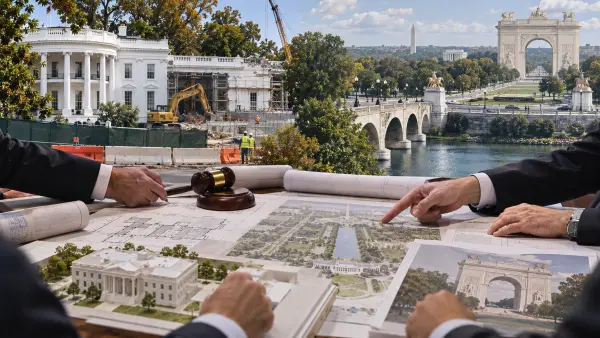
Washington, DC, looks the way it does because of decisions spread across federal agencies, review panels, Congress and the courts. Much of the land in the city’s monumental core belongs to the federal government, so changing it is a national question as well as a local one. Two projects pushed by President Donald Trump, a ballroom on the site of the White House’s former East Wing and a triumphal arch at the Virginia end of Arlington Memorial Bridge, have turned this little-known system into front-page news.
Who Owns and Runs the Landmarks
Different landmarks have different managers. The National Park Service, part of the Interior Department, runs the National Mall, most of the major memorials and President’s Park, which includes the White House grounds. The General Services Administration manages most federal office buildings, the Architect of the Capitol cares for the Capitol complex, and the Smithsonian Institution runs its museums with a mix of federal and private money. Each of these bodies falls under the jurisdiction of congressional committees that oversee its work and set its budget.
Who Reviews New Projects
A major federal project in the capital usually passes through at least one review commission. The National Capital Planning Commission, created in 1924, has approval power over federal projects in the region. Its members include presidential appointees, DC appointees, federal agency heads and congressional committee chairs, and the president names its chair. The Commission of Fine Arts, created in 1910, is an advisory panel of presidential appointees that comments on design. Projects may also need an environmental assessment under federal environmental law and a review of their effects on historic sites, and a 1910 law limits building heights.
New memorials follow a separate law. The Commemorative Works Act of 1986 divides the area around the National Mall into zones. Under that law, a commemorative work placed in the central zone, known as Area I, needs an act of Congress approving its location. That rule reflects the separation of powers: the Constitution gives Congress power over federal property, while the executive branch manages it day to day.
Who Pays
Congress funds the agencies that run these sites through annual appropriations. New memorials, however, are usually built with private money raised by a sponsoring group, and agencies also accept gifts through nonprofit partners. The Park Service has rules for these philanthropic partnerships meant to stop a donor from gaining influence over government decisions.
The White House Ballroom
The White House announced a privately funded ballroom in July 2025, and crews began demolition of the East Wing that October, before either commission had reviewed the plans. The administration argued that review was required only for new above-ground construction. Donations flow through the Trust for the National Mall, a nonprofit partner of the Park Service. A funding agreement released after a public-records lawsuit showed that the Trust collects a 2.5 percent fee on the roughly $400 million project and that donors can request anonymity.
The Commission of Fine Arts, whose members Trump had replaced in October 2025, approved the design in February 2026. The planning commission, then chaired by a senior White House aide, voted 8 to 1 to approve it on April 2, 2026, with two members voting present. Days earlier, U.S. District Judge Richard Leon had issued a preliminary injunction, finding that the National Trust for Historic Preservation was likely to win its argument that the ballroom needs congressional authorization. A divided federal appeals court upheld his order in August. The Supreme Court then granted a stay in a 5 to 4 vote on August 31, finding that the Trust likely lacks standing to sue, without deciding whether the project is legal. Leon’s order never took effect, and construction has continued while the case goes on.
Money has also become a question for Congress. In May 2026, Senate Republicans proposed $1 billion for Secret Service security work, and the agency said $220 million of it would go to hardening the ballroom site. Supporters said a secure event space protects the president, while critics, including some Republicans, objected to taxpayers paying for part of a project promised as privately funded. Reports in late May said Senate Republicans were expected to drop the provision, and this article could not confirm whether any of that money was later approved.
The Triumphal Arch
Trump first showed models of an arch in October 2025 to mark the nation’s 250th anniversary. The site, Memorial Circle on Columbia Island, is Park Service land on the ceremonial route between the Lincoln Memorial and Arlington National Cemetery. The Commission of Fine Arts approved the design concept in May 2026, and on November 5 the planning commission gave the 250-foot arch final approval by an 8 to 4 vote.
The legal fight centers on authority. The administration says a 1925 law tied to Arlington Memorial Bridge already authorized a monument at the circle, so no new vote by Congress is needed. Veterans, the District of Columbia, Virginia and Arlington County have sued, arguing that the site falls under the Commemorative Works Act or that environmental review was inadequate. Within an hour of the vote, U.S. District Judge Tanya Chutkan issued a 14-day temporary restraining order, writing that the government’s reading of the old law shows “how far defendants must stretch” to justify the project.
Critics also say the arch would interrupt the vista across the Potomac that was designed to symbolize national reunion after the Civil War. Funding is less clear than for the ballroom. This article could not locate a published cost estimate from the White House, and officials have described a mix of public and private money. CBS News reported that the National Endowment for the Humanities reserved $2 million, plus up to $13 million to match private gifts, for the arch.
The Debate
Supporters of the administration’s approach argue that presidents have reshaped the White House many times, that a large and secure event space is overdue, and that both review commissions approved the projects. They note that President Joe Biden also removed members of both commissions in 2021, so replacing appointees has precedent. Some also say the arch completes a plan from the 1920s that was never finished.
Critics argue that the process ran backward, with demolition before review, and that commissions led by the president’s own aides cannot act as independent checks. They say anonymous donations to a president’s project create conflict-of-interest risks, and that only Congress can authorize permanent changes of this size on public land. Beneath these disputes is a broader question: when a president wants to change the shared symbols of the capital, how much say should Congress, local governments, the courts and the public have?
Glossary
jurisdiction (noun): the official power to make decisions about a particular area, subject or group.
Translations: 管辖权 | 管轄権 | 관할권 | अधिकार क्षेत्र | اختصاص | юрисдикция | jurisdicción | compétence
- The White House grounds fall under the jurisdiction of the National Park Service.
- Lawmakers argued over which committee had jurisdiction over the funding request.
commission (noun): an official group of people given the job of reviewing, controlling or deciding something.
Translations: 委员会 | 委員会 | 위원회 | आयोग | لجنة | комиссия | comisión | commission
- The planning commission meets once a month to review federal projects.
- A new commission was formed to study the city’s building rules.
advisory (adjective): able to give advice or recommendations but not to make binding decisions.
Translations: 咨询性的 | 諮問的な | 자문의 | सलाहकारी | استشاري | консультативный | consultivo | consultatif
- The design panel plays an advisory role, so agencies are not required to follow its views.
- She was invited to join an advisory board for the new museum.
environmental assessment (noun): a formal study of how a proposed project could affect the natural and human environment.
Translations: 环境评估 | 環境影響評価 | 환경 평가 | पर्यावरणीय आकलन | تقييم بيئي | экологическая оценка | evaluación ambiental | évaluation environnementale
- The agency released an environmental assessment before approving the new road.
- Critics said the environmental assessment ignored traffic problems near the site.
commemorative work (noun): a memorial, monument, statue or similar structure built to honor a person, group or event.
Translations: 纪念建筑 | 記念建造物 | 기념물 | स्मारक कृति | عمل تذكاري | мемориальное сооружение | obra conmemorativa | œuvre commémorative
- Every new commemorative work in the area must follow federal rules on location and design.
- The veterans’ group raised money for a commemorative work honoring nurses who served in the war.
separation of powers (noun): the division of government power among separate branches so that no single branch controls everything.
Translations: 三权分立 | 権力分立 | 권력 분립 | शक्तियों का पृथक्करण | فصل السلطات | разделение властей | separación de poderes | séparation des pouvoirs
- The case raised questions about the separation of powers between Congress and the president.
- Teachers often use the budget process to explain the separation of powers.
appropriation (noun): money that a legislature officially sets aside for a specific government purpose.
Translations: 拨款 | 歳出予算 | 예산 책정 | विनियोजन | اعتماد مالي | ассигнование | asignación presupuestaria | crédit budgétaire
- The museum’s annual appropriation covers staff salaries and building repairs.
- Without a new appropriation, the agency cannot start the project.
philanthropic (adjective): related to giving money or help to good causes, especially through donations.
Translations: 慈善的 | 慈善の | 자선의 | परोपकारी | خيري | благотворительный | filantrópico | philanthropique
- The park depends on philanthropic gifts to restore its oldest fountains.
- She started a philanthropic foundation to support public libraries.
donor (noun): a person or organization that gives money or goods to a cause.
Translations: 捐赠者 | 寄付者 | 기부자 | दानदाता | متبرع | жертвователь | donante | donateur
- Each donor received a thank-you letter from the foundation.
- The largest donor asked that the gift be used for repairs.
demolition (noun): the act of deliberately tearing down a building or structure.
Translations: 拆除 | 解体 | 철거 | ध्वस्तीकरण | هدم | снос | demolición | démolition
- The demolition of the old wing took only a few days.
- Residents protested the demolition of the historic theater.
anonymity (noun): the condition of having one’s name or identity kept secret.
Translations: 匿名 | 匿名性 | 익명성 | गुमनामी | عدم الكشف عن الهوية | анонимность | anonimato | anonymat
- Some donors gave large amounts on the condition of anonymity.
- The reporter promised the source anonymity.
preliminary injunction (noun): a court order that stops an action while a lawsuit is still being decided.
Translations: 初步禁令 | 仮差止命令 | 예비적 금지명령 | प्रारंभिक निषेधाज्ञा | أمر قضائي أولي | предварительный судебный запрет | medida cautelar | injonction provisoire
- The judge granted a preliminary injunction to pause the project until trial.
- A preliminary injunction is not a final ruling on who is right.
authorization (noun): official permission to do something, often given by law.
Translations: 授权 | 授権 | 승인 | प्राधिकरण | تفويض | санкционирование | autorización | autorisation
- The agency said it already had authorization to build the monument.
- Opponents argued that only Congress could give authorization for the change.
stay (noun): a court order that temporarily stops another court decision from taking effect.
Translations: 暂缓执行 | 執行停止 | 집행 정지 | स्थगन | وقف التنفيذ | приостановление исполнения | suspensión | sursis à exécution
- The appeals court issued a stay, so the lower court’s order did not take effect.
- The government asked the Supreme Court for a stay while it appealed.
standing (noun): the legal right to bring a lawsuit, based on having suffered a real and specific harm.
Translations: 诉讼资格 | 原告適格 | 원고 적격 | वाद दायर करने का अधिकार | الصفة في التقاضي | право на иск | legitimación procesal | qualité pour agir
- The court dismissed the case because the group lacked standing.
- To show standing, the plaintiffs described how the project affected them personally.
temporary restraining order (noun): a short emergency court order that blocks an action for a limited time, usually until a fuller hearing.
Translations: 临时限制令 | 一時的差止命令 | 임시 금지명령 | अस्थायी निषेधाज्ञा | أمر تقييدي مؤقت | временный запретительный приказ | orden de restricción temporal | ordonnance restrictive temporaire
- The temporary restraining order blocked construction for 14 days.
- Lawyers rushed to court to seek a temporary restraining order before work began.
vista (noun): a long, pleasant view, especially one that has been planned or framed.
Translations: 景观视线 | 眺望 | 조망 | दृश्य | منظر ممتد | перспектива | perspectiva visual | perspective
- The planners protected the vista from the hilltop to the river.
- A tall tower would change the famous vista along the avenue.
precedent (noun): an earlier action or decision used as an example or justification for a later one.
Translations: 先例 | 先例 | 선례 | पूर्व उदाहरण | سابقة | прецедент | precedente | précédent
- Supporters said earlier renovations set a precedent for the new project.
- The ruling could become a precedent for future disputes over federal land.
Discussion Questions
- Have you ever visited a national monument or memorial? What made it memorable?
- Should a president be able to make major changes to the White House without asking Congress?
- Who should decide what new monuments are built in a capital city?
- Is it a problem if review panels are led by people the president appointed?
- Should donors to government building projects be allowed to stay anonymous?
- Do you find the administration’s argument based on the 1925 law convincing?
- Why do you think the Supreme Court decided the ballroom case on standing rather than on whether the project is legal?
- Should taxpayers pay for security features on a privately funded project?
- How important is it to protect historic views and landscapes in a city?
- Why do monuments and public buildings so often become politically controversial?
- What are the advantages and disadvantages of letting courts pause construction projects?
- Imagine you are on the National Capital Planning Commission. How would you have voted on the arch?
Related Links
- Commemorative Works Act: Siting Memorials in the District of Columbia (Congressional Research Service)
- Monumental Arch Project Synopsis, November 2026 (National Capital Planning Commission)
- Federal agency approves Trump’s plan for triumphal arch ahead of America 250 (Washington Examiner)
- Monumental Arch: Statements and Filings (National Trust for Historic Preservation)
- Who’s Paying for the White House Ballroom? (FactCheck.org)
