
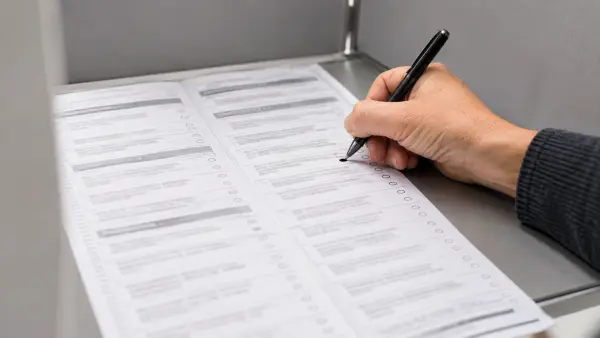
Voters in dozens of states decided statewide ballot measures on Nov. 3, and the results did not line up neatly with the Democratic sweep in congressional races. Abortion-rights supporters won three of four abortion contests. Voter ID and citizenship-to-vote measures passed in most states that considered them. Missouri voters rejected a Republican-drawn congressional map, and several high-profile measures are still being counted.
Background
Ballot measures let voters approve or reject laws and constitutional amendments directly. Some reach the ballot through citizen petitions, while others are referred by state legislatures. NPR counted 146 statewide measures on this year’s ballots. Many grew out of national fights: abortion after the 2022 Dobbs decision, President Trump’s push for mid-decade redistricting, and the Republican campaign for stricter voting rules, including the stalled SAVE America Act in Congress.
The Results by Topic
Abortion. Nevada’s Question 6, which writes a right to abortion up to fetal viability into the state constitution, passed with more than 60%, according to State Court Report’s results review. It was the measure’s required second approval. Virginia approved a reproductive freedom amendment. In Missouri, 55% voted against Amendment 3, a legislative referral that would have repealed the abortion-rights amendment adopted in 2024 and also banned gender transition procedures for minors. Idaho was the exception: 56% voted against Proposition 1, keeping the state’s near-total ban in place.
Voting rules. Alaska, Arkansas, Kansas, South Dakota and West Virginia approved measures stating that only U.S. citizens can vote. Ohio, North Carolina and Nevada added photo ID requirements to their constitutions. Voter ID did not win everywhere. California’s Proposition 39 and Colorado’s Amendment 84, a mail-ballot ID measure, both failed, and Arizona rejected a measure combining a noncitizen voting ban, voter ID and a ban on foreign election money. Virginia approved restoring voting rights to people with felony convictions once they leave prison, and Massachusetts approved same-day voter registration.
Redistricting. Missouri voters rejected Proposition A by 62% to 38%, blocking the 2025 map that split the Kansas City district held by Democratic Rep. Emanuel Cleaver. The 2022 lines stay in place. Maryland approved an amendment that clears the way for a new congressional map in a state where Republicans hold one district. Colorado’s Amendment 86, which would make redrawing maps before 2028 harder, was too close to call, with “no” ahead.
Taxes. Early results showed Washington voters keeping a new state tax on income over $1 million, scheduled to take effect in 2028. California’s Proposition 40, a one-time 5% tax on the wealth of about 200 billionaires, was trailing in early counts. Proposition 42, a billionaire-backed countermeasure written to block the tax, was leading. Utah rejected Amendment B, which would have required 60% voter approval for certain tax changes.
What Different Sides Are Saying
Conservatives argue that their policies outperformed their candidates. Writing in National Review’s The Corner, Tanner Nau noted that North Carolina’s voter ID amendment passed by 19 points on the same night Democrat Roy Cooper won the Senate race by the same margin. He argued that voter ID laws “remain popular across the political spectrum.” Fact-check: Polling supports part of this claim. The Associated Press reported that a majority of Democratic voters also favor voter ID, though support is stronger among Republicans. The ballot record is less uniform than the claim suggests: ID measures failed in California and Colorado. The citizenship amendments also mostly restate existing law, since noncitizens already cannot vote in federal elections, although they could stop cities from allowing noncitizens to vote in local races.
Abortion-rights and voting-access advocates point to Missouri as the clearest signal. State Court Report, published by the Brennan Center for Justice, which supports expanded voting access, wrote that Missouri voters “pushed back against their legislators” on abortion, maps and initiative rules. Fact-check: The Missouri results are as described: voters also approved Amendment 6, which makes it harder for lawmakers to change voter-approved initiatives. The broader picture is mixed, however. Idaho kept its ban, and Colorado narrowly approved a ban on gender transition surgeries for minors with just over 51%.
On the Missouri map, Kansas City Mayor Quinton Lucas said voters had “rejected a rigged map.” Gov. Mike Kehoe, who backed the map, issued a statement after the vote, but this article could not access its full text. Fact-check: “Rigged” is an opinion. What reporting documents is the map’s purpose: KCUR described it as aimed at ousting Cleaver. This article could not locate a statement from national Democratic leaders on the voter ID and citizenship results.
What Is Still Pending
Alaska’s Ballot Measure 2, which would repeal ranked-choice voting and open primaries, was trailing with “no” at 51.9% in election-night results. A similar repeal failed narrowly in 2024 after late ballots shifted the count. Alaska plans to certify results on Nov. 25. California is still counting Propositions 40, 41 and 42; if either countermeasure passes with more votes than Proposition 40, the tax could be blocked. Colorado’s Amendments 85 and 86 and Washington’s Measure 638 on transgender athletes in school sports were also uncalled in the reporting reviewed here.
Related Links
- What 2026 Ballot Measure Results Tell Us (State Court Report)
- Where Voters Stand on State Ballot Measures (NPR)
- Election-Security Ballot Referenda Survived the Blue Wave (National Review)
- Missouri Voters Reject Trump-Backed Congressional Map (Missouri Independent)
- California Billionaire Tax Trails in Early Results (KQED)
- Missouri Court Blocks GOP Map, Orders November Vote (PoliTalking.US)
- How Redistricting Works: Maps, Gerrymandering, and the 2026 Fights (PoliTalking.US)
Discussion Questions
- Does your state or country let voters decide laws directly? Have you ever voted on one?
- Why might voters support Democratic candidates and conservative ballot measures at the same time?
- Should major issues like abortion be decided by voters or by elected lawmakers?
- Do you find the conservative or the progressive reading of these results more convincing?
- Is it useful to pass a citizenship-to-vote amendment if the rule already exists in law?
- Why do you think voter ID passed in Ohio but failed in California?
- Should voters be able to reject maps drawn by their legislature?
- How much should campaign spending influence a ballot measure result?
- Why do results sometimes change after Election Night in states like Alaska and California?
- Imagine you are writing a ballot measure. What issue would you put directly before voters, and why?
