
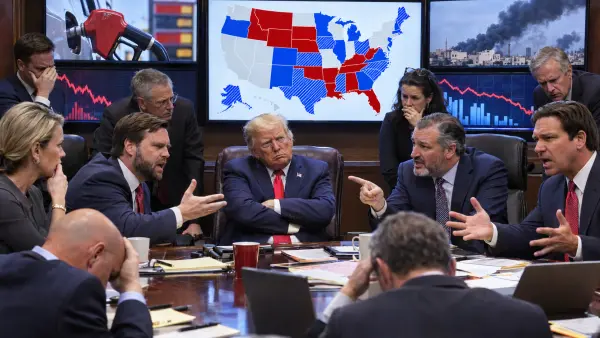
Republicans lost control of both the House and the Senate on Nov. 3, and within hours the party’s officials, strategists and media figures were arguing over why. Some blame the war with Iran. Others point to prices and tariffs, to corruption, or to a party they say drifted away from conservative principles. Another camp says the problem was that President Donald Trump’s agenda was never fully delivered. These are early interpretations, offered before every race has been called, and the evidence behind each is still partial.
Background
Democrats flipped at least seven Republican-held Senate seats, in Texas, Kansas, Ohio, Iowa, North Carolina, South Carolina and Maine, and won a large House majority. It is the first time since 2006 that a Republican president has lost both chambers in a midterm. House totals were still shifting as of Nov. 5, with dozens of races uncalled and CBS News estimating a final Democratic count of 251 to 268 seats.
Trump’s own account has been mixed. He told reporters it was “largely true” that the war raised energy prices and cost Republicans both chambers, while saying he would make the same decision again. He has also pointed to his absence from the ballot and said Fox News bore some responsibility for interviewing Democrats. House Speaker Mike Johnson said on Nov. 4 that he will not seek the post of minority leader. What follows are the main explanations circulating on the right, grouped by the argument they make.
The War Was the Deciding Factor
JD Vance. The vice president, widely seen as a leading contender for the 2028 nomination, made the bluntest case in a social media post: “The reason we lost is the war.” Vox’s Andrew Prokop noted that Vance also mentioned the cost of living, immigration enforcement and public views of Israel, and floated openness to changing how immigration enforcement is carried out, while ruling out amnesty. But the war was the center of his argument, and he said that losing the Senate for years to come was not worth it. Trump acknowledged early in the conflict that Vance had been less enthusiastic about going into Iran, though Vance largely stood by the decision in public.
The America First media. Writing in The Federalist, John Daniel Davidson called the collapse “overwhelmingly President Donald Trump’s fault” and dismissed explanations about weak candidates or poor turnout operations. His argument is that 2024 Trump voters wanted two things, no new Middle East wars and mass deportations, and received a war they were promised they would not get. Commentator Matt Walsh made a similar point on X, blaming Trump personally for launching an unpopular war and abandoning the America First message.
Fact-check: Exit polls support the claim that the war mattered, but they differ on how central it was. In the NBC News exit poll, 34% of voters called the war a crucial factor and 40% a major factor, and Democrats won roughly 62% to 63% of that combined group, depending on the report. The AP’s voter survey found 6 in 10 voters thought military action against Iran was the wrong decision, but only about one-third called it crucial, and more voters cited the cost of living and government corruption. The two findings are not contradictory; they measure different things. Separating the war from prices is also difficult, since rising gas prices were one of the war’s most visible effects at home.
“Not a Single Issue”: The Hawks Push Back
Mark Levin. The talk radio host, a strong supporter of the war, rejected the idea that one issue explained the loss. “The mid-terms were not lost over a single issue,” he posted on X. To the extent the war did hurt Republicans, he argued, the fault lay with America First voices who spent months campaigning against it.
Blaming the messengers. A related argument targets right-leaning podcasters. Joel Berry, a former managing editor of The Babylon Bee, blamed hosts including Tucker Carlson and Candace Owens for demoralizing their listeners. The fight also ran in the other direction: according to The Washington Post’s Scott Nover, Federalist co-founder Sean Davis accused Ben Shapiro of helping push the war that hurt the party, after Shapiro posted a meme about the returns. Much of this debate is less about voters than about who inside the movement owns the decision to go to war.
Context: These are claims about influence and motivation. This article could not locate any data measuring whether podcast criticism of the war affected Republican turnout.
Prices, Tariffs and Candidates Who Seemed Not to Care
Ted Cruz. The Texas senator, whose state elected a Democratic senator and governor, called the result a “Watergate-level repudiation.” He said the war had dragged on too long, but he put more weight on prices: gas and diesel costs, electricity bills he tied to data centers, an economy he described as K-shaped, with gains concentrated among the well-off, and tariffs that he said made everything too expensive. His sharpest criticism was aimed at his own side. In remarks reported by CBS News, he said many Republican candidates appeared not to understand or care about the cost of living.
Other voices on affordability. Commentator Benny Johnson warned that Republicans would keep losing the affordability argument unless they ended the war and brought prices down. Activist Christopher Rufo said voters were unhappy about the economy, the war and corruption, and that the problem was policy, not messaging.
Disputed: Cruz’s claim that tariffs drove prices up is contested on the right. Commentator Ryan James Girdusky argues tariffs did not produce the economic damage critics predicted (see below). The two positions reflect a long-running split between free-market and populist Republicans, and this early in the post-election period neither side has offered new evidence.
A Rejection of Washington Republicans
Ron DeSantis. The outgoing Florida governor described the results as close to an extinction-level event for the party and called them a rebuke of both Trump and the Republican Congress, with Democrats, independents and some Republicans crossing over. He said voters were frustrated with how little Republicans in the House and Senate had produced. He said he knew the party was in trouble when he saw it spending heavily on ads about transgender issues, which he said were not motivating voters; the AP counted more than $180 million in such ads by late October. He also criticized the administration’s handling of immigration enforcement under former Homeland Security Secretary Kristi Noem and cited corruption, including a reported $10 million-a-year contract for Trump lawyer Alina Habba.
Marjorie Taylor Greene. The former congresswoman, who resigned in January after breaking with Trump, called the election a total referendum on the president, saying Republicans stood behind him “silently clapping like trained baby seals.” Before the vote she had tied a loss to broken promises on foreign wars and the Epstein files.
Fact-check: Exit polls back the claim that corruption was a major concern: roughly 9 in 10 voters called government corruption a major factor, and Republican favorability stood at 40% against 47% for Democrats, according to the same CBS News report. The figure for Habba’s contract is as reported; this article could not independently verify it.
Conservatism Abandoned
John Curtis. The Utah senator published a blog post on election night arguing that Republicans gave up traditional conservative principles to win elections. In an interview with the Deseret News, he said the party misread voter frustration over the border, inflation and spending as a mandate for mass deportations, disruptive tariffs and foreign intervention. He welcomes the working-class voters Trump brought in but says populist promises conflict with a conservative agenda, and he rejected calls to push Trump’s approach further. “Democrats didn’t win,” Curtis said, arguing that Republicans lost because they failed to learn from earlier setbacks. He pointed to Secretary of State Marco Rubio as an example of the blend he wants.
Others in this camp. Commentator Erick Erickson listed a broad set of grievances, from the war and gas prices to corruption, tariffs, deportations and the White House ballroom project. Former Senator Mitt Romney said he hoped the defeat would prompt a course correction.
Context: This is an argument about values and direction, not a checkable claim. Exit polls show voters were unhappy with outcomes such as prices and the war, but they cannot show whether voters rejected the policies themselves or how they were carried out.
The Agenda Was Never Delivered
The populist case. An anonymous Republican operative who worked on 2026 Senate campaigns told the Deseret News that candidate scandals were not the problem and that Republicans did not go too far right. “The style won the presidency,” the operative said, arguing that governance failed to match it, especially on lowering prices and staying out of Middle East conflicts. The prescription is to keep Trump’s populist, anti-establishment identity and deliver on it.
Ryan James Girdusky. The commentator argues that tariffs did not cause the harm critics predicted. The real failure, in his view, was that the administration’s major tax and spending law did little for affordability while gas prices, interest rates and health insurance costs kept rising. He has also pointed to a shift in sentiment among young people on TikTok after the war began.
Blaming congressional leaders. Commentator Breanna Morello blamed Speaker Johnson and Senate Majority Leader John Thune for failing to turn Trump’s executive orders into law. Gateway Pundit founder Jim Hoft blamed Thune for not passing the SAVE America Act, which Thune had said lacked the votes to advance. Whether passing it would have changed the outcome is a counterfactual that cannot be tested.
What the Disagreement Is Really About
Prokop observed that most Republicans now agree the party has an affordability problem but disagree about its cause and its cure. Free-market conservatives want fewer tariffs and less debt, while populists want more direct economic relief, and large deficits limit room for new tax cuts in either direction. The debate also maps onto the 2028 field: Vance is seen as the leading figure of the populist-nationalist wing, DeSantis is weighing another run, and Curtis’s preferred model points toward Rubio. Which explanation wins inside the party may shape who it nominates as much as what it promises. Survey data that tracks individual voters, which usually takes weeks or months to publish, should show which accounts hold up.
Related Links
- Republicans blame Trump for midterm losses, while Trump points elsewhere (NewsNation)
- Republicans turn on Trump after midterm losses hand Democrats control of Congress (Fox News)
- Tim Burchett, Ben Shapiro and other conservatives explain what went wrong (Yahoo News)
- The US-Iran War: Ceasefire Breakdown, Renewed Strikes, and a Last-Ditch Push for Talks
- Texas Senate 2026: Paxton vs. Talarico
- The SAVE America Act: Why It Has Become a Flashpoint Between Trump and Congress
Discussion Questions
- When a party loses an election, why do its members often disagree so strongly about the cause?
- Which explanation in this article do you find most convincing, and why?
- Vance says the war was the main reason. What evidence in the article supports him, and what complicates his view?
- Why might two exit polls give different answers about how much the Iran war mattered?
- Can a party separate its leader’s choices from its own performance in an election? Explain.
- Have you ever seen a group blame outsiders, rather than itself, after a failure? What happened?
- Curtis says “Democrats didn’t win.” What does he mean, and do you agree?
- Imagine you are a Republican strategist preparing for 2028. Which lesson from this election would you focus on first?
- How much responsibility do media personalities have for the way their audiences vote?
- Do you think the explanation a party accepts after a loss shapes who it chooses as its next leader?
