
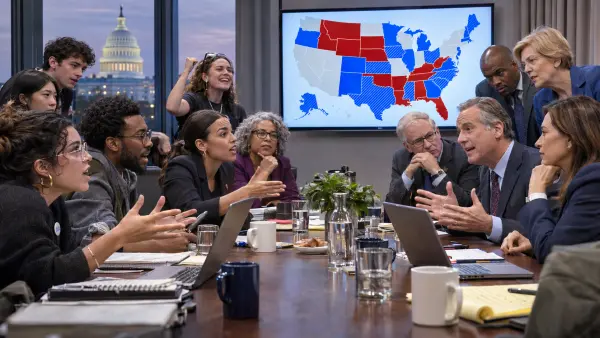
Democrats won control of both chambers of Congress on Nov. 3, and almost immediately began arguing over who deserves the credit and what voters asked for. Progressives say the results reward economic populism and a willingness to fight President Donald Trump. Moderates say the decisive wins came in Republican-leaning states where centrist candidates appealed to independents. Party leaders are stressing affordability and unity, while some senators-elect are already questioning who should lead them. These are early readings; the votes are not fully counted and detailed voter data is still weeks away.
Background
Democrats flipped at least seven Republican-held Senate seats and gained more than two dozen House seats, with dozens of House races still uncalled as of Nov. 5. Winners came from across the party. Progressives Abdul El-Sayed and Troy Jackson won Senate races in Michigan and Maine, while more moderate and establishment candidates flipped seats in Kansas, Iowa, North Carolina and South Carolina and won governor’s races in Michigan and Wisconsin. In Texas, James Talarico defeated Ken Paxton in a race both factions now claim.
The argument was anticipated. A POLITICO poll released before the election found that the bigger the Democratic win, the more Democratic voters were inclined to see it as a mandate for more progressive candidates, with both progressives and moderates moving in that direction if the party swept key races. Before the vote, a 45% plurality of self-identified moderates said a narrower win would mean the party should nominate more moderates.
Progressives: Voters Chose Economic Populism
The populist case. Adam Green, co-founder of the Progressive Change Campaign Committee, argued that Talarico won Texas by attacking billionaire power, Wall Street and Big Tech, and that insiders debating whether Talarico is a moderate or a progressive are missing the point. Usamah Andrabi of Justice Democrats said party leaders “finally listened to the left” by campaigning on affordability and taking on corporate interests. Representative Pramila Jayapal called for bold populist change of the kind candidates ran on.
Using the majority aggressively. Representative Greg Casar, who chairs the Congressional Progressive Caucus, urged the Senate to abolish the filibuster next year so a Democratic majority can pass progressive legislation. He has warned that Democrats could lose the 2028 presidential race if voters do not see them as on their side. Other progressive advocates want aggressive corruption investigations, opposition to mass deportations and no funding for the Iran war.
Abdul El-Sayed. The Michigan senator-elect, the first Muslim elected to the U.S. Senate, won with backing from Senator Bernie Sanders despite being outspent and despite Senate Democratic leader Chuck Schumer supporting his primary opponent. The day after the election he declined to endorse Schumer for another term as leader. “I do believe we need new leadership,” he said. Randy Villegas, who won a California House seat, said progressives had to beat their own party and that he would not do the bidding of any party leader.
Fact-check: El-Sayed’s win is real, but its size is part of the dispute. Governor-elect Jocelyn Benson won Michigan by nearly 11 points, about four points more than El-Sayed’s Senate margin, according to the AP. Progressives read that as a strong showing for a Midwestern progressive; moderates read the gap as a progressive penalty. The numbers support either reading, and they do not settle it.
Moderates: The Majority Makers Won the Red States
Third Way. Jim Kessler, executive vice president for policy at the centrist think tank and a former Schumer aide, called it a spectacular night for moderate Democrats, crediting flips in Kansas, Iowa and South Carolina. He argued that El-Sayed benefited from a favorable national environment rather than a mandate for progressive policy. “In a normal year, in a neutral year, El-Sayed probably doesn’t win Michigan,” Kessler told The Washington Sun.
Rahm Emanuel and the Blue Dogs. Former White House chief of staff Rahm Emanuel, who is considering a 2028 run, said the party should focus most on the candidates who flipped Republican seats, calling them the majority makers. The centrist Blue Dog Coalition more than doubled its membership, with at least 22 endorsed candidates winning. New Democrat Coalition chair Brad Schneider stressed cooperation over factional claims.
Fact-check: The AP’s voter survey offers data for both sides. About half of voters backing Democratic House candidates described themselves as moderates, up from roughly 4 in 10 in 2018, 2022 and 2024, and moderates made up about half of the winning candidates’ voters in the flipped Kansas, Iowa and North Carolina Senate races, according to the same AP report. The same survey found that about one-third of Democratic voters identify as democratic socialists, including just under half of those aged 18 to 29. A coalition can be both more moderate overall and more left-leaning among its youngest voters.
Fight Harder or Govern?
The confrontation camp. Ezra Levin, co-executive director of the progressive group Indivisible, said the results mean Democrats must push harder than they did during the shutdown fight and votes on Trump’s nominees. “Voters didn’t flip Congress for polite hearings and strongly worded letters,” he said. Indivisible leaders have also urged senators to oppose Schumer remaining as leader.
The governing camp. Senator Mark Kelly of Arizona, a potential 2028 candidate, said Democrats now have to govern, which means legislation will need some Republican votes to reach the president’s desk. Schumer said the first priority is lowering costs he blames on Trump, followed by tackling corruption, and he appeared cool to the idea of another House impeachment. House Democratic leader Hakeem Jeffries pointed to areas where progressives, New Democrats and Blue Dogs already agree, such as reversing Medicaid cuts and extending Affordable Care Act tax credits, rather than broader goals like Medicare for All.
Somewhere in between. Illinois Governor JB Pritzker, also weighing a 2028 run, said Congress should “walk and chew gum at the same time,” lowering consumer costs while holding accountability hearings on the administration. He released a 200-point policy agenda for the incoming Congress.
Context: Whether voters wanted confrontation or results is a question of interpretation. A pre-election AP-NORC poll found that 80% of registered voters wanted lowering the cost of living to be a top priority for the next Congress and 68% said the same of ending the Iran war, while investigations of Trump ranked lower, including among Democrats. That poll measured priorities, not how hard voters want Democrats to fight.
Earned, or Lent? The Referendum Reading
Chris Van Hollen. The Maryland senator, a progressive, cautioned against reading too much into the win. He told the AP that midterms are mainly a judgment on the party in power and that the result does not automatically mean support for Democrats, who still have to earn it. He has not decided whether to back Schumer and is considering his own 2028 run.
The big tent. Democratic strategist Eddie Vale argued that the party needs different kinds of candidates in different places and that neither faction has a single formula. An unnamed national Democratic operative made a similar point, saying everyone won because the party ran as a big tent. Incoming Representative Christina Bohannan of Iowa, whose district is politically mixed, said most new Democrats are focused on lowering costs and expects them to get along if that remains the focus.
Fact-check: The referendum reading has support in the exit polls. Trump’s approval stood at 38% in the CBS News exit poll, and Democrats’ favorability, at 47%, was higher than Republicans’ 40% but still below a majority, according to a CBS News summary of the exit polls. Disapproval of the other side can produce a large win without broad enthusiasm for the winners.
Leadership and the Road to 2028
Much of the argument is a preview of the 2028 presidential primary. Representative Ro Khanna, who is weighing a run, said he expects an open fight over the party’s ideology. Van Hollen, Kelly, Emanuel and Pritzker are all considering campaigns, and each has offered a different reading of the midterms that fits his own case. Schumer is still expected to keep his post as leader, and no challenger has been named. The first test of which reading prevails will come in January, when the new majorities choose their leaders and decide which bills to bring up first.
Related Links
- Sweeping Democratic wins fuel divide between progressives and centrists (The Hill)
- So Who’s Running the Party Now: Progressives or Moderates? (The New Republic)
- What the 2025 Results Tell Us (Third Way)
- Michigan Senate: Rogers vs. El-Sayed
- Texas Senate 2026: Paxton vs. Talarico
- Maine Senate 2026: Collins vs. Jackson After the Reset
Discussion Questions
- Why do winning parties often argue as much as losing parties after an election?
- Should a party that wins a large victory move toward its base or toward the center?
- What do progressives and moderates each see in the Michigan Senate result?
- Van Hollen says Democrats still have to earn voters’ support. Do you agree that a midterm win can be “lent” rather than earned?
- Is it better for a new majority to confront the president or to look for compromise? Explain.
- Have you ever been part of a team that won but disagreed about why? How was it resolved?
- Why might a party’s youngest voters hold different views from its older voters?
- Imagine you are a newly elected member of Congress from a district that voted for Trump in 2024. What would your first priority be?
- Should a newly elected senator publicly question the party’s leader before taking office?
- How might this debate shape the 2028 presidential primary?
