
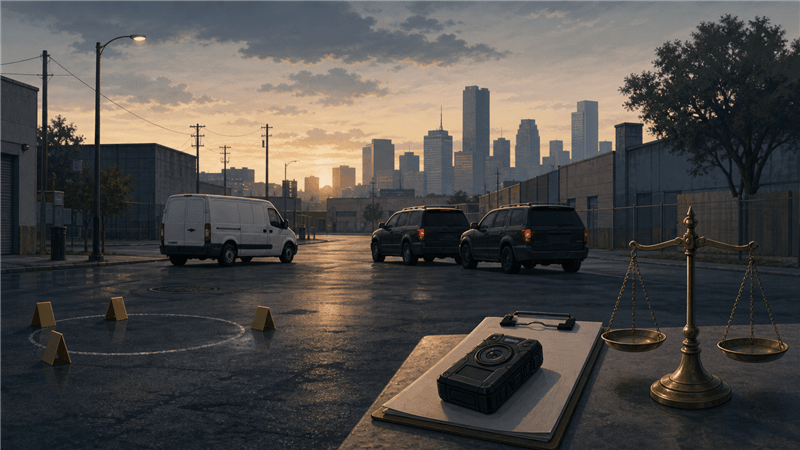
What Happened
A U.S. Immigration and Customs Enforcement officer shot and killed 52-year-old Lorenzo Salgado Araujo during an attempted vehicle stop in Houston on July 7, 2026. Salgado Araujo, a Mexican national who had lived in the United States for more than 35 years, was driving a white work van in Houston’s East End. Federal officials later said he was not the person ICE agents originally intended to find.
The Department of Homeland Security, which oversees ICE, said Salgado Araujo ignored commands, struck or rammed an ICE vehicle, and created a danger that caused an officer to fire in self-defense. Three passengers who were in the van gave a sharply different account through their lawyer. They said federal vehicles surrounded the van, an officer fired through the passenger-side window, and Salgado Araujo did not threaten the officer.
The available public record does not resolve that conflict. DHS has not released video or other physical evidence supporting its account. The ICE agents involved were not wearing body cameras, and officials have not publicly identified the officer who fired. As of July 13, Harris County District Attorney Sean Teare said federal officials had not provided the officers’ identities or invited his office into the investigation.
Background
The shooting occurred during a major expansion of federal immigration enforcement. ICE officers were conducting what DHS called a targeted operation, although Salgado Araujo was not the original target. His passengers were detained after the shooting. The incident prompted protests, demands for an independent investigation, and questions about the authority of local officials to examine conduct by federal officers.
DHS’s Office of Inspector General is leading the federal review. The FBI has also participated, including an examination of whether Salgado Araujo assaulted federal officers. Houston police were not involved in the stop or shooting. Mayor John Whitmire first said the city lacked independent jurisdiction, then directed the police department to seek a role and offer assistance. Harris County prosecutors also opened their own inquiry but warned that federal control of evidence could limit what they can determine.
The dispute also renewed attention to body cameras. Congress previously provided DHS with $20 million for body-worn cameras. Federal officials had promised to expand their use after other deadly immigration-enforcement encounters, but DHS confirmed that the Houston ICE officers did not have them. A body camera would not automatically settle every question, but footage could provide evidence about vehicle movement, officer positions, warnings, and the timing of the shots.
What Is Known and What Remains Unclear
- Confirmed: An ICE officer fired the shots that killed Salgado Araujo during an attempted stop on July 7.
- Confirmed: Salgado Araujo was not the original target of the federal operation.
- Confirmed: The agents involved were not wearing body cameras.
- Disputed: DHS says Salgado Araujo rammed a federal vehicle and endangered an officer. The passengers say the officer was not threatened.
- Not publicly established: No publicly released video, reconstruction, forensic report, or final investigative finding currently proves either account.
- Still unclear: The public does not know the firing officer’s identity, employment history, administrative status, or exact location when the shots were fired.
What Different Sides Are Saying
DHS and ICE: The department presents the shooting as a lawful act of self-defense during an enforcement operation. Its account says Salgado Araujo attempted to evade officers and used his vehicle in a way that threatened them. DHS says withholding the officer’s name protects the officer and family members from threats.
Witnesses and the family’s supporters: The passengers’ lawyer says their account contradicts the federal version. Family members, immigration advocates, and several elected officials are asking for an investigation independent of DHS. They argue that the absence of body-camera footage and the limited release of evidence make outside review especially important.
Local officials: Houston and Harris County officials have focused on access to evidence rather than announcing a final conclusion. Teare says the lack of federal cooperation is unusual compared with local officer-involved shooting investigations. Whitmire says the city wants transparency, but local investigators face jurisdictional and practical limits because the officers and much of the evidence are under federal control.
Mexico: Mexican officials have said they will ask U.S. authorities to pursue criminal complaints concerning deaths of Mexican nationals in immigration operations and custody, including this case. That request is not the same as a finding that a crime occurred. U.S. investigators and prosecutors would still need to evaluate evidence and applicable law.
Fact Check
Claim: Salgado Araujo was the target of a targeted ICE operation.
Finding: False. Federal officials have acknowledged that agents were initially looking for someone else.
Claim: Public evidence proves Salgado Araujo tried to run over an officer.
Finding: Not established. DHS has made that allegation, but witnesses dispute it and DHS has not released evidence that conclusively confirms it.
Claim: The lack of body-camera footage proves the federal account is false.
Finding: Unsupported. The absence of footage reduces transparency and removes a potentially important source of evidence. It does not by itself prove either account.
Claim: Houston police are conducting a full investigation with the same access they would have in a local police shooting.
Finding: False as of July 13. Local officials say federal authorities control critical evidence and have not fully included them.
Claim: Mexico has already brought criminal charges against the ICE officer.
Finding: False. Mexico has said it will request that complaints or charges be considered in the United States. No publicly reported criminal charge has been filed against the officer in this case.
Why It Matters
The case tests how federal law-enforcement officers are investigated when a person dies and local authorities dispute their access to evidence. It also raises broader questions about whether an agency should investigate its own officers, when officer identities should be disclosed, and how body-camera rules should apply during immigration operations.
The central facts remain unsettled. A fair assessment requires separating confirmed details from official allegations, witness accounts, and political arguments. Final conclusions should depend on physical evidence, forensic analysis, interviews, and investigative findings that have not yet been made public.
Related Links
- Harris County says federal officials are withholding key information (Associated Press)
- What to know about the fatal Houston ICE shooting (Associated Press)
- Witnesses dispute the federal account (Associated Press)
- ICE body-camera rollout faces new scrutiny (Associated Press)
- Harris County prosecutor discusses evidence access (The Texas Tribune)
- Houston seeks a role in the investigation (The Texas Tribune)
Discussion Questions
- What detail in the two accounts seems most important?
- How should readers respond when official and witness accounts conflict?
- Have body cameras affected trust in policing where you live?
- Should federal officers be required to use body cameras?
- Who should investigate a federal officer’s use of deadly force?
- When should an officer’s identity become public?
- Does the lack of video change how you assess the claims?
- Why can federal and local investigations come into conflict?
- What evidence is needed before reaching a conclusion?
- Imagine you lead the investigation. What information would you seek first?
