
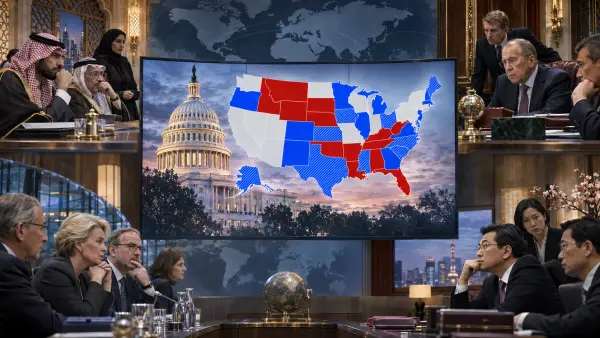
Foreign governments watched the 2026 midterm results closely, and their readings of what happened often say as much about their own concerns as about American voters. Iran’s chief negotiator declared that Americans had voted against war. Russian officials warned that Democrats are hostile to Moscow. Many European leaders welcomed the result, though some doubted it would change much in practice. Most governments, from Beijing to Tokyo, kept their public statements cautious and described the vote as an internal American matter.
Background
Democrats won both chambers of Congress on Nov. 3 after a campaign shaped in part by issues with direct international stakes: the war with Iran that began in February, Russia’s war in Ukraine, and a series of tariff disputes, including an escalating trade war with Canada. Congress controls federal spending and has formal powers over war and trade, though in recent decades presidents have acted with considerable independence in both areas. That gap between formal powers and practice runs through many of the reactions below.
Iran: “No to War”
Mohammad Bagher Ghalibaf. The speaker of Iran’s parliament, who also serves as its chief negotiator in talks with the United States, posted on X that “Americans said NO TO WAR, and we endorse this message.” He warned that if the U.S. government ignores public opinion, Iran’s refusal would come with consequences. The English-language Tehran Times ran the headline that the war had come home to hit Trump at the ballot box.
Other Iranian voices. Supreme Leader Mojtaba Khamenei said that shifts between parties in Washington would not change what he called American hostility toward Iran. Deputy parliament speaker Ali Nikzad tied the Republican setback to Washington’s failure to pressure Iran through sanctions and economic measures, TRT World reported.
Fact-check: Ghalibaf’s claim is partly supported. In the AP’s Election Day survey, about 6 in 10 American voters said the United States made the wrong decision in taking military action against Iran, but only about one-third called the war crucial to their vote, and more cited the cost of living and corruption. President Trump has acknowledged the war was part of the reason for his party’s losses but defended the decision. The vote was a setback for the war’s leading supporters, but exit polls do not show it was mainly a vote about Iran. Analysts had argued before the election that Tehran was trying to raise the war’s costs to hurt Trump at the polls. In pre-election reporting carried by The Boston Globe, Johns Hopkins professor Vali Nasr said that humiliating Trump in the elections offered Iran satisfaction without escalating further.
Russia and Ukraine
Russian officials. Deputy Foreign Minister Sergei Ryabkov said the approach of the Democratic Party’s activist wing toward Russia is extremely negative, while signaling no major change in Russian policy. Kremlin spokesman Dmitry Peskov said he hoped the results would not affect what he called Trump’s peacemaking efforts.
Russian state media. The government daily Rossiyskaya Gazeta took a different angle, telling Brussels to brace itself and arguing that after the defeat, Trump’s anger would fall on Europe. The paper also argued the results would hurt Ukraine, according to NPR’s roundup. This is a prediction, not a reported fact.
Ukraine. The Kyiv Independent’s headline described the result as a blow to Trump and a potential boost for Ukraine. This article could not locate an official statement from the Ukrainian government on the results.
Europe: Hope, With Doubts
The optimists. European Parliament Vice President Christel Schaldemose said she was cautiously optimistic on Europe’s behalf, but added that the EU must keep standing on its own two feet. Spanish Prime Minister Pedro Sánchez went further, presenting the result as part of a broader retreat of the far right and saying the same would happen in Spain. Norwegian Prime Minister Jonas Gahr Støre called it a powerful signal of a change of course among American voters. British Prime Minister Andy Burnham said that with Trump accepting the results, attention could turn to ending wars and bringing down prices.
The skeptics. German Chancellor Friedrich Merz suggested Trump would probably govern by executive order and questioned why things would be any different now. His defense minister, Boris Pistorius, congratulated Democrats on a historic victory but urged Europe to do more for its own security. French Finance Minister Roland Lescure said Paris would watch whether Trump changes course, especially on gasoline prices and foreign involvement. French politician Raphaël Glucksmann welcomed the outcome but warned that Trump still holds great influence over international affairs.
Context: The skeptics echo pre-election analysis. Nevada Joan Lee of the European Council on Foreign Relations argued that a Democratic Congress would still struggle to constrain the president on foreign policy, trade and sanctions, and that Europeans should plan for Trump to remain the decisive foreign policy actor until 2028. Sánchez’s claim about a retreating far right is an opinion about political trends beyond the United States, not something the U.S. results can confirm. For background on Congress’s war powers, see The War Powers Resolution.
Israel
Prime Minister Benjamin Netanyahu did not immediately comment. Israel had held its own elections the previous week, and his opponents quickly used the U.S. results in their own arguments. Opposition leader Yair Golan said the vote showed how unpopular Netanyahu has become among both Democrats and Republicans and warned of growing isolation under his government. Yair Lapid said the results ruled out any unity government led by Netanyahu. Both statements are claims about Israeli politics; the U.S. midterms were not a vote on Netanyahu, though Middle East policy was part of the debate.
North America
Canada’s Toronto Star called the results a rebuke to Trump, and Mexico’s El Universal headlined them as a setback for him. This article could not locate an official statement from either government. Before the vote, Canadian Prime Minister Mark Carney said Canada was in no rush to sign a trade deal with Washington and, for the first time, suggested Ottawa might wait until Trump’s term ends. Whether a Democratic Congress changes that calculation is an open question, since tariff decisions have largely come from the White House.
Asia and Africa
China. Foreign Ministry spokesperson Mao Ning called the election an internal U.S. affair and said Beijing wants a constructive strategic relationship with Washington. Earlier in the year, veteran Chinese diplomat Bian Qingzu warned that a Democratic Congress could bring “renewed volatility” to relations, reflecting concern in Beijing that congressional pressure on China could grow.
Japan. Chief Cabinet Secretary Minoru Kihara said the alliance with the United States remains the cornerstone of Japan’s foreign and security policy regardless of the outcome, and that Tokyo would monitor financial markets closely.
South Africa and India. South African President Cyril Ramaphosa said the election could usher in a new era in world relations, while acknowledging that recent U.S. trade measures pose challenges and saying his country will seek new export markets. In India, The Times of India headlined the result as midterm blues for Trump; this article could not locate a statement from the Indian government.
What the Reactions Show
The pattern across these statements is consistent. Governments in open conflict or competition with Washington, such as Iran and Russia, read the results through their own disputes. Close allies such as Japan and Greece stressed continuity, with Greek government spokesman Pavlos Marinakis saying relations would remain strong. European leaders split between those who see the vote as a turning point and those who expect Trump to keep acting largely on his own. Which group proves right will depend less on the vote itself than on how far a Democratic Congress uses its powers over spending, war and trade in the next two years.
Related Links
- Global leaders react to Democrats’ sweeping congressional win (Axios)
- Trump tamed after US midterms? Europe doubts it (AFP via EWN)
- Trump’s Iran war now has a midterm election problem (Al Jazeera)
- The US-Iran War: Ceasefire Breakdown, Renewed Strikes, and a Last-Ditch Push for Talks
- Learn: How US Foreign Policy Decisions Actually Become Binding
- Gordie Howe Bridge Opens as U.S.-Canada Tariff Fight Deepens
Discussion Questions
- Why do foreign governments care about elections for a legislature in another country?
- Why do you think most governments described the vote as an internal U.S. matter?
- Iran’s negotiator said Americans voted “no to war.” How does the exit poll evidence in this article support or complicate that claim?
- Why might the same election result be read as good news in one capital and bad news in another?
- How much can a legislature limit a leader’s foreign policy? Think of your own country as an example.
- Did the US midterms get much attention where you live? How were they described?
- Why might politicians in other countries use U.S. results in their own domestic arguments?
- Imagine you are a diplomat from a country in a trade dispute with the United States. Would you wait for a new administration or negotiate now?
- Do you think Merz or the optimists will turn out to be right about how much will change?
- What role should allies play in responding to political changes in a partner country?
