
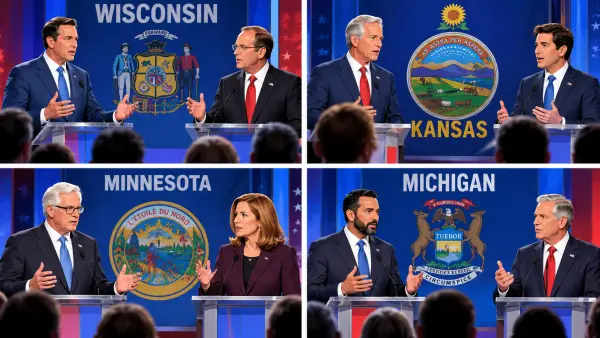
Five debates in four races since the Oct. 15 dispatch put governor and Senate candidates on stage in Wisconsin, Kansas, Minnesota and Michigan between Oct. 19 and Oct. 21. Candidates traded accusations on taxes, fraud, the Iran war, and ties to Trump or to national Democrats, and several checkable claims drew disputes. This dispatch covers the four races with usable reporting, says where the record is thin, and does not pick winners. It follows our Oct. 15 Alaska and Maine dispatch.
Wisconsin Governor: Taxes, Data Centers and Abortion
Democrat David Crowley, the Milwaukee County executive, and Republican U.S. Rep. Tom Tiffany met on Oct. 21 at Marquette University Law School in what Wisconsin Public Radio described as the only debate of the general election. The hour was contentious, and neither candidate offered many numbers behind his proposals.
Taxes and the surplus. Tiffany said he would return the state’s projected surplus, which he put at about $3 billion, through income and property tax cuts, including a 10% cut for families earning under $150,000. He opposed one-time rebate checks and said economic growth would cover the lost revenue, without specifics. Crowley defended a bipartisan county sales tax increase, called for a broad overhaul of the state tax system, and criticized Tiffany’s vote for the federal tax law Trump signed in 2025. Pressed on a new top income tax bracket, Crowley gave no rate or threshold.
Fact-check: Tiffany said taxes rose every year under Crowley, and this article could not verify that. A pre-debate review by Wisconsin Watch answered no to two attack lines that were repeated on stage. Tiffany’s claim that Crowley wants to remove half of the state’s prison population overstates Crowley’s support for a gradual 50% reduction goal. Crowley’s claim that Tiffany gave tax breaks to data center builders rests on business provisions in the 2025 federal law that apply across many industries, and Congress never voted on a data center break by name.
Data centers. Both candidates said they back limits on data center development. Tiffany accused Crowley of changing his position on repealing the state’s data center sales tax exemption. Crowley said he has long been open to reform, would sign a repeal bill, and supports pausing existing projects for a statewide environmental review. WPR noted that the Republican-led Legislature wrote the exemption into the 2023 state budget and Democratic Gov. Tony Evers signed it. For a comparison, see our post on New York’s data center moratorium.
Abortion. Tiffany pledged to keep Wisconsin’s 20-week limit and said he would not sign a six-week ban like one he backed in Congress. Crowley said he would push to protect abortion access in the state constitution but did not directly answer whether he would sign a bill allowing abortion with no gestational limit, saying such a bill would not reach his desk. Tiffany described that answer as support for abortion through nine months, a position Crowley did not state. Crowley questioned whether voters should trust Tiffany’s pledge given his congressional record.
The 2020 election. Tiffany signed onto a Supreme Court lawsuit seeking to overturn swing-state results in 2020 and voted to object to Pennsylvania’s and Arizona’s results. On stage he said his main objection was roughly $15 million in private election funding that he said went mostly to Democratic cities. Crowley responded that Tiffany had alleged no wrongdoing in how votes were cast. Both committed to certifying the 2028 presidential result. This article could not verify the $15 million figure, which WPR did not check.
Coverage: WPR emphasized the policy exchanges and the missing numbers behind them, while Wisconsin Watch tested the attack lines the campaigns had been running. Background on the race is in our Wisconsin governor briefing.
Kansas Senate: A Tied Race and Personal Attacks
Republican Sen. Roger Marshall and Democratic challenger Adam Hamilton, a United Methodist pastor, met on Oct. 21 in the final scheduled debate, hosted by FOX4 in Kansas City, KCUR reported. The same report cited an early-October New York Times/Siena poll with each candidate at 45% and 6% undecided.
Policy differences. Marshall defended Trump’s tariffs as bringing jobs back, while Hamilton called them too broad and unpredictable. Both want the Iran war to end, but Marshall backed Trump’s reasoning and voted against a war powers resolution. The Social Security tax applies only to the first $184,500 of income. Marshall said he would eliminate that cap, a position closer to some Democrats, and Hamilton said it should be lifted. Neither backed raising the retirement age. Both rejected Medicare for All. They also split on Trump’s agreement to buy Russian diesel, which Marshall backed and Hamilton called selling out Ukraine.
Personal attacks. Marshall called Hamilton a moderate in name only, pointed to his past changes in party affiliation, and said he would be beholden to Sen. Chuck Schumer. KCUR said a Schumer-linked political action committee has spent $5 million in the race. Hamilton said he would not vote for Schumer as leader. Marshall also repeated a line from his campaign ad accusing Hamilton of protecting an abuser at a church camp. Hamilton said a 2005 internal inquiry was inconclusive because the boys could not identify the perpetrator, that the person returned to camp in 2006, that he should have checked, and that he later helped get the abuser jailed. Marshall disputed how attack ads have portrayed his own lawsuits against former patients over unpaid bills, and said he gave free care to many.
Fact-check: The church camp timeline is Hamilton’s account as reported by KCUR, and this article could not locate an independent record of the 2005 inquiry. Whether outside spending makes a candidate beholden is an opinion, not a checkable claim, and Hamilton’s pledge on Schumer cannot be tested until a leadership vote. This article also could not verify what Trump said last year about Iran’s nuclear capabilities, as Hamilton described it, or the terms of the diesel agreement.
Coverage: KCUR’s headline framed the race as one on which control of the Senate could turn, and its report said Marshall’s Social Security position surprised some observers. Headlines from other national outlets, which this article could not open in full, stressed a fiery tone and Republican breaks with Trump. KCUR’s own account shows Marshall defending tariffs and the Iran war vote while breaking with party orthodoxy on one issue.
Minnesota Governor: Fraud, Walz and Insulin
U.S. Sen. Amy Klobuchar, a Democrat, and Minnesota House Speaker Lisa Demuth, a Republican, debated twice in three days. The first, on Oct. 19 in Brainerd, was hosted by the Minnesota Chamber of Commerce and centered on the state economy, KAXE reported. Both said they would not raise taxes and agreed that local communities should decide on data centers.
Walz and fraud. Demuth said Klobuchar had never distanced herself from Gov. Tim Walz and had been silent on fraud in state safety-net programs. Klobuchar said she would have caught the fraud, that she helped add prosecutors in the U.S. Attorney’s office after the 2022 Feeding Our Future scandal broke, and that she would not have made a pardon Walz voted for, according to the Minnesota Reformer. This article could not verify either side’s account of who did what on fraud.
Insulin. The sharpest exchange on Oct. 19 was over insulin. Demuth cited her vote for the 2020 Alec Smith Insulin Affordability Act. Klobuchar said Smith’s mother, who supports Klobuchar, has called it a watered-down version of what her family wanted. The Reformer reported the week before that Demuth said in questionnaires she voted to cap insulin prices but had voted against insulin-capping legislation at least twice. Fact-check: Both candidates are partly right. Demuth did vote for the 2020 act, and she also has votes against separate cap bills. Whether the 2020 law counts as a cap is the disputed part, and this article did not review the roll calls.
Steel mill. Asked why the Mesabi Metallics steel mill is going to Iowa, Klobuchar criticized Iowa’s offer of up to $1.4 billion in incentives for about 1,750 permanent jobs, which works out to roughly $800,000 per job. Demuth called the loss an example of the Walz status quo and said she would address permitting uncertainty.
The final debate. On Oct. 21 in Rochester, FOX 9 reported, the candidates covered fraud, housing, gas prices, health care, gang violence, data centers, the Boundary Waters mining ban and abortion. Demuth called Minnesota a “state in crisis” and promised to replace state commissioners. Klobuchar pledged 100,000 housing units and tied gas prices to the Iran war. The sharpest clash was over guns: Klobuchar accused Demuth of lying about her response to the Annunciation school shooting, saying she had not allowed a vote on a gun safety package, and Demuth denied lying and said bills would go through the legislative process. Klobuchar also said Demuth backs abortion bans with no exceptions for rape or incest, and FOX 9 reported that Demuth did not directly address that.
Fact-check: This article could not verify either account of the gun vote, Klobuchar’s claim that about 8 million people lost health coverage, or Demuth’s claims about law enforcement endorsements and silenced whistleblowers.
Coverage: The Reformer’s headline stressed how quickly Klobuchar distanced herself from Walz, while KAXE organized its account around the economy and business climate. FOX 9 gave more space to guns and abortion.
Michigan Senate: A Second Round on Costs and Trump
Republican Mike Rogers and Democrat Abdul El-Sayed met for a second televised debate on Oct. 21 on WXYZ, ClickOnDetroit reported. Rogers cited lost manufacturing jobs in Michigan, high utility rates and high auto insurance rates, and accused El-Sayed of wanting to raise taxes. El-Sayed said he would lower the cost of living and accused Rogers of standing with Trump on policy. Topics also included Canadian tariffs, the Iran war, health care and immigration enforcement.
Fact-check: The report did not quantify Rogers’s claims on manufacturing jobs, utility rates or insurance costs, and this article could not verify them. This article also could not locate El-Sayed’s reply on taxes or a fuller account of the health care and immigration exchanges. Only one local account of this debate was available. The race background is in our Michigan Senate briefing.
View from Outside the US
Canadian Press coverage of the first Michigan debate on Oct. 8, republished by CTV News, framed Trump’s trade war with Canada as a live midterm issue. Canadian tariffs were on the list of topics again at the Oct. 21 rematch. This article could not locate non-US coverage of the Wisconsin, Kansas or Minnesota debates.
Note on Scope
This dispatch covers five debates in four races between Oct. 19 and Oct. 21 and relies on published reporting, not full transcripts or video. Kentucky’s Senate debate on Oct. 20 and Connecticut’s governor debate on Oct. 22 are not covered because this article could not retrieve substantive reporting on them. It could not open pages from CNN or NBC News, so it does not rely on their accounts. Michigan rests on a single local report. Fact-checks apply to specific claims, not to a candidate’s overall performance, and the dispatch does not judge who won.
Related Links
- Crowley, Tiffany spar over taxes, data centers and abortion in only debate of governor’s race
- Wisconsin governor election: 11 claims about candidates Crowley, Tiffany and the facts
- 8 questions Crowley and Tiffany didn’t answer during their only debate
- Here are 4 takeaways from the first Demuth-Klobuchar debate
- Marshall and Hamilton clash at last Kansas Senate debate
- Michigan Senate: Rogers vs. El-Sayed
- Wisconsin Governor 2026: David Crowley vs. Tom Tiffany
Discussion Questions
- Have you ever watched a full candidate debate? What did you learn from it?
- Do debates change how people vote, or do they mostly confirm existing views?
- Crowley and Tiffany gave few numbers for their tax plans. How much detail should voters expect?
- Wisconsin had only one governor debate, while Minnesota had two in three days. How many debates are enough?
- Should moderators correct false claims on the spot, or leave that to fact-checkers afterward?
- How should candidates answer a hypothetical question, such as an abortion bill they expect never to see?
- Why do so many Senate and governor races focus on a candidate’s ties to Trump or to national Democrats?
- Marshall and Hamilton traded personal attacks. Do such attacks help or hurt a candidate?
- Why do voters trust local reporters, national outlets or campaign ads differently?
- Imagine you are a debate moderator. What three questions would you ask in the final week of a campaign?
